


















Introduction
Across Dubai, a common concern keeps coming up in homes, clinics, and even school cafeterias: children are not eating enough vegetables.
Parents try everything. They chop vegetables smaller, hide them in sauces, or offer rewards. Yet the result is often the same—refusal, frustration, and wasted food.
When nutritionists in Dubai talk about kids eating vegetables UAE, they rarely focus on “tricks.” Instead, they point to patterns. Small, repeated habits that shape how children see food over time.
Interestingly, this issue is not just about parenting. It connects to how vegetables are sourced, stored, presented, and even how fresh they are when they reach the plate.
In a city like Dubai—where produce comes from both local farms and global imports—understanding these details matters more than most people realize.
This article breaks down what is actually going wrong, based on real-world insights from nutritionists, food buyers, and supply professionals in the UAE.
The Real Problem Isn’t Taste—It’s Familiarity
Most parents assume children reject vegetables because of taste. Bitter flavors, soft textures, or unfamiliar smells.
But in practice, nutritionists working with children vegetables diet Dubai cases often highlight something else: lack of exposure.
Children tend to accept foods they see often. Not once or twice—but consistently.
What Typically Happens at Home
- Vegetables are served irregularly
- New vegetables are introduced too late (after age 5–6)
- Meals are rushed, with little time for exploration
- Parents themselves avoid certain vegetables
Over time, vegetables become “unfamiliar,” not “disliked.”
Why This Matters in Dubai
In Dubai households, especially those relying on imported produce:
- Vegetable variety changes frequently
- Seasonal items appear and disappear quickly
- Families rotate between cuisines
This inconsistency makes it harder for children to build familiarity.
A child who sees broccoli once every two weeks is far less likely to accept it than one who sees it daily—even if they don’t eat it every time.
Mistake #1: Treating Vegetables as a Side, Not the Meal
One of the most common patterns nutritionists observe is how vegetables are positioned on the plate.
They are often:
- An afterthought
- A small portion next to rice or meat
- Served last, when the child is already full
The Behavioral Impact
Children naturally prioritize what looks important.
If vegetables appear small, separate, and optional, they are perceived as less important.
A Practical Shift
Instead of asking, “How do I get my child to eat vegetables?”
Reframe the meal:
- Build dishes where vegetables are central
- Combine vegetables with familiar textures (rice, wraps, pasta)
- Serve vegetables first when the child is most hungry
In many healthy food kids Dubai meal plans, vegetables are not a side—they are integrated into the main structure of the meal.
Mistake #2: Ignoring Texture (This Is Bigger Than Taste)
Texture plays a bigger role than most parents realize.
In clinical discussions around picky eater vegetables UAE, texture sensitivity is one of the most consistent factors.
Common Texture Issues
- Mushy zucchini or overcooked spinach
- Fibrous green beans
- Watery tomatoes
- Dry, bitter eggplant
Children are highly sensitive to these inconsistencies.
Where Supply Chain Matters
This is where food sourcing becomes important.
Vegetables that:
- Travel long distances
- Sit in storage too long
- Are harvested too early
…often lose their natural texture.
In practice, suppliers working closely with Dubai-based distributors such as JMB Farm Fresh often observe that fresher produce tends to hold its structure better during cooking. This directly affects how children experience the food.
Practical Takeaway
- Lightly cook vegetables instead of overcooking
- Test texture before serving
- Use roasting or grilling instead of boiling when possible
A crisp carrot or slightly charred broccoli is more appealing than a soft, overcooked version.
Mistake #3: Overcomplicating “Healthy Eating”
In Dubai, there is growing awareness around nutrition. But sometimes, this leads to overcomplication.
Parents try to:
- Introduce multiple new vegetables at once
- Follow strict diet plans
- Replace all familiar foods suddenly
What Nutritionists Recommend Instead
Keep it simple.
Children respond better to:
- Repetition
- Predictability
- Small changes over time
For example:
- Add one vegetable to a familiar dish
- Repeat it several times in a week
- Keep preparation consistent
This approach is more effective than constantly introducing new foods.
Mistake #4: Hiding Vegetables Too Well
Blending vegetables into sauces or smoothies is a common tactic.
It works—temporarily.
But it creates a hidden problem.
The Long-Term Effect
Children may consume nutrients, but they don’t:
- Recognize vegetables visually
- Learn to accept their natural form
- Build confidence around new foods
This delays real progress.
A Better Approach
Use a mix of both:
- Some hidden vegetables (for nutrition)
- Some visible vegetables (for learning)
Even small visible pieces can help children become more comfortable over time.
Mistake #5: Not Paying Attention to Freshness and Quality
This is rarely discussed in parenting advice, but it matters.
Vegetables that are:
- Wilted
- Slightly bitter
- Lacking color
…are much harder for children to accept.
Why This Happens in the UAE
Dubai relies on a mix of:
- Imported produce (Europe, Asia, Africa)
- Regional suppliers
- Local greenhouse farming
Because of this, quality can vary significantly depending on:
- Season
- Storage conditions
- Supply chain timing
Real-World Observation
Many families unknowingly compare:
- A fresh, crisp carrot (pleasant taste)
vs - A stored, slightly aged carrot (bitter or dull)
Children react differently—even if the vegetable is the same.
Practical Takeaway
When possible:
- Choose vegetables with strong color and firmness
- Avoid items that feel soft or dehydrated
- Use vegetables within a few days of purchase
This small change often improves acceptance more than expected.
Mistake #6: Forcing Instead of Guiding
Pressure is one of the fastest ways to create resistance.
Common patterns include:
- “Finish your vegetables first”
- “No dessert unless you eat this”
- Repeated persuasion during meals
What Happens Over Time
Children begin to associate vegetables with:
- Stress
- Control
- Negative emotions
This makes rejection stronger.
What Nutritionists Suggest
- Offer vegetables consistently without pressure
- Allow children to explore at their own pace
- Accept that refusal is part of the process
In many nutritionist Dubai kids food consultations, progress is measured over weeks—not meals.
A Quick Reality Check for Parents in Dubai
Many families assume their situation is unique.
It’s not.
Across Dubai households:
- Busy schedules reduce meal consistency
- Reliance on delivery or ready-made food increases
- Produce quality varies week to week
These factors quietly influence how children interact with vegetables.
Understanding this context helps shift the focus from blame to adjustment.
What Most Articles Don’t Explain Clearly
A lot of online advice repeats the same tips:
- “Make food fun”
- “Use colorful plates”
- “Cut vegetables into shapes”
These are helpful—but incomplete.
What they often miss:
- The role of supply quality
- The impact of seasonality
- The importance of repeated exposure
- The difference between short-term tricks and long-term habits
In the UAE, where produce sourcing is more complex than in many countries, these factors become even more important.
Seasonal Reality: Why Winter Changes Everything
In the UAE, winter (November to March) is a key period for fresh produce.
During this time:
- Regional farms supply more vegetables
- Leafy greens improve in quality
- Root vegetables are more consistent
Why This Matters for Children
Better quality produce often means:
- Sweeter taste
- Better texture
- More appealing appearance
This is one of the easiest times of year to introduce vegetables to children.
Families who struggle during summer often see improvement in winter—without changing anything else.
A Smarter Way to Think About “Fun Vegetables”
Instead of forcing creativity, focus on familiarity and quality.
For example:
- Roasted carrots with slight caramelization
- Simple cucumber slices with consistent crunch
- Lightly sautéed spinach with minimal seasoning
These are not “fun” in a decorative sense—but they are approachable.
In discussions around fun vegetables children UAE, the most effective solutions are often the simplest ones.

What Happens Between Farm and Plate (And Why It Affects Your Child)
Most parents focus on cooking methods. Few think about what happens before the vegetables reach the kitchen.
In Dubai, produce typically follows a longer journey than in countries with year-round local farming.
A Simplified Supply Chain
- Harvested locally or internationally
- Transported (air or sea freight)
- Stored in temperature-controlled facilities
- Distributed to wholesalers and retailers
- Purchased and stored again at home
Each step can affect:
- Texture
- Flavor
- Nutritional quality
- Shelf life
Why This Matters for Children
Children are more sensitive to small changes in food quality.
A slightly bitter cucumber or a soft bell pepper may go unnoticed by adults—but children often reject it immediately.
Common Misunderstanding
Many assume:
“Vegetables are vegetables.”
In reality, two batches of the same item can feel completely different depending on:
- Harvest timing
- Storage duration
- Handling conditions
For families trying to improve kids eating vegetables UAE, consistency matters as much as creativity.
The Hidden Cost of Inconsistent Buying
In discussions among restaurant buyers and catering teams in Dubai, one issue comes up repeatedly: inconsistency.
The same applies at home.
What Inconsistency Looks Like
- Buying from different stores each week
- Switching between premium and budget options
- Choosing based on appearance alone
- Ignoring seasonality
The Result at Home
- Vegetables taste different each time
- Cooking results vary
- Children lose trust in familiar foods
For a child, inconsistency creates uncertainty:
“Sometimes I like this. Sometimes I don’t.”
Over time, the safer option becomes refusal.
Wholesale vs Retail: What Families Often Get Wrong
This topic usually comes up in business conversations, but it applies to households too.
Retail Buying (Supermarkets)
Pros:
- Convenience
- Wide variety
- Ready-to-use packaging
Limitations:
- Longer storage times
- Higher handling exposure
- Greater variability in freshness
Wholesale-Oriented Supply
Pros:
- Shorter time from distribution to use
- Often better batch consistency
- Suitable for frequent cooking
Tradeoffs:
- Larger quantities
- Requires planning
- Less curated presentation
Some UAE families quietly shift toward semi-wholesale sourcing (through local markets or delivery services) not for price—but for consistency.
This is particularly relevant when managing children vegetables diet Dubai, where repeat exposure to similar-quality produce improves acceptance.
How to Judge Vegetable Quality (Without Overthinking It)
Many parents rely only on visual appeal. But a glossy surface does not always mean better quality.
Here are simple, practical checks used by experienced buyers:
1. Firmness
- Carrots should feel solid, not flexible
- Cucumbers should snap slightly when bent
- Bell peppers should not feel hollow or soft
2. Weight
- Heavier vegetables usually retain more moisture
- Lightweight produce may indicate dehydration
3. Smell
- Fresh vegetables have a mild, clean scent
- Sour or overly strong smells suggest aging
4. Leaf Condition (for greens)
- Leaves should be crisp, not wilted
- Avoid yellowing edges
These small checks can improve the eating experience significantly—especially for children.
Why “One Bad Experience” Can Undo Progress
Children form strong food memories.
If a vegetable tastes unpleasant once, it can create lasting resistance.
Example Scenario
- A child tries spinach that is slightly bitter or overcooked
- They associate spinach with that experience
- Future attempts are rejected immediately
What This Means
Consistency matters more than frequency.
It is better to serve:
- The same vegetable
- Cooked the same way
- With consistent quality
…than to constantly introduce new items with variable results.
The Role of Meal Timing and Environment
Another factor often overlooked in nutritionist Dubai kids food discussions is timing.
When Vegetables Are Served Matters
Children are more likely to accept vegetables when:
- They are slightly hungry
- The meal is not rushed
- There are minimal distractions
Common Challenges in Dubai Homes
- Late dinners due to work schedules
- Screen distractions during meals
- Quick, convenience-based eating
These reduce the chance of children engaging with their food.
Building a Repeatable System (Not Just a One-Time Fix)
Instead of trying new strategies every week, focus on building a simple system.
Step 1: Choose 3–4 Core Vegetables
Select items that are:
- Easy to cook
- Available most of the year
- Mild in flavor
Examples:
- Carrots
- Cucumbers
- Spinach
- Zucchini
Step 2: Standardize Preparation
Cook them the same way each time.
- Same level of doneness
- Same seasoning
- Same presentation
Step 3: Repeat Consistently
Serve these vegetables regularly.
Not forcing consumption—but maintaining exposure.
Step 4: Introduce One New Item Slowly
Once acceptance improves, add one new vegetable at a time.
This method is widely used in managing picky eater vegetables UAE cases because it reduces uncertainty.
Why Parents’ Own Habits Matter More Than Advice
Children observe more than they follow instructions.
If vegetables are:
- Rarely eaten by adults
- Treated as optional
- Discussed negatively
…children pick up on that quickly.
A Simple Observation
In households where adults regularly eat vegetables without emphasis, children tend to accept them more naturally.
This is less about discipline—and more about environment.
The Dubai Factor: Convenience vs Control
Dubai offers one of the most convenient food environments in the world.
- Grocery delivery
- Pre-cut vegetables
- Ready-made meals
While convenient, this can reduce control over:
- Freshness
- Preparation
- Ingredient quality
For families trying to improve healthy food kids Dubai, small shifts toward home preparation—even partial—can make a noticeable difference.
When “Healthy” Becomes Overwhelming
Another pattern seen in urban households is overcorrection.
Parents move from:
- Minimal vegetables
…to:
- Strict, fully controlled diets
This often leads to resistance.
A Balanced Approach
- Maintain familiar foods
- Gradually increase vegetable presence
- Avoid labeling foods as “good” or “bad”
Children respond better to balance than restriction.
A Note on Local vs Imported Produce
In the UAE, both local and imported vegetables play a role.
Local Produce (Seasonal)
- Often fresher
- Shorter supply chains
- Better texture during peak season
Imported Produce
- Provides year-round availability
- May vary in freshness depending on origin
Understanding this helps families adjust expectations.
For example:
- Leafy greens are typically better in UAE winter
- Some imported vegetables may be less consistent in summer
Aligning choices with seasonal strengths can improve outcomes without changing cooking habits.
What Families and Food Buyers Have in Common
Interestingly, many of the same principles used by restaurants apply at home:
- Consistent sourcing
- Understanding seasonality
- Prioritizing freshness over appearance
- Standardizing preparation
Whether managing a kitchen for hundreds of guests or a household of four, the fundamentals remain the same.
Practical Ways to Make Vegetables More Acceptable (Without Overthinking It)
By this point, the pattern becomes clear: improving how children eat vegetables is less about creativity and more about consistency, quality, and environment.
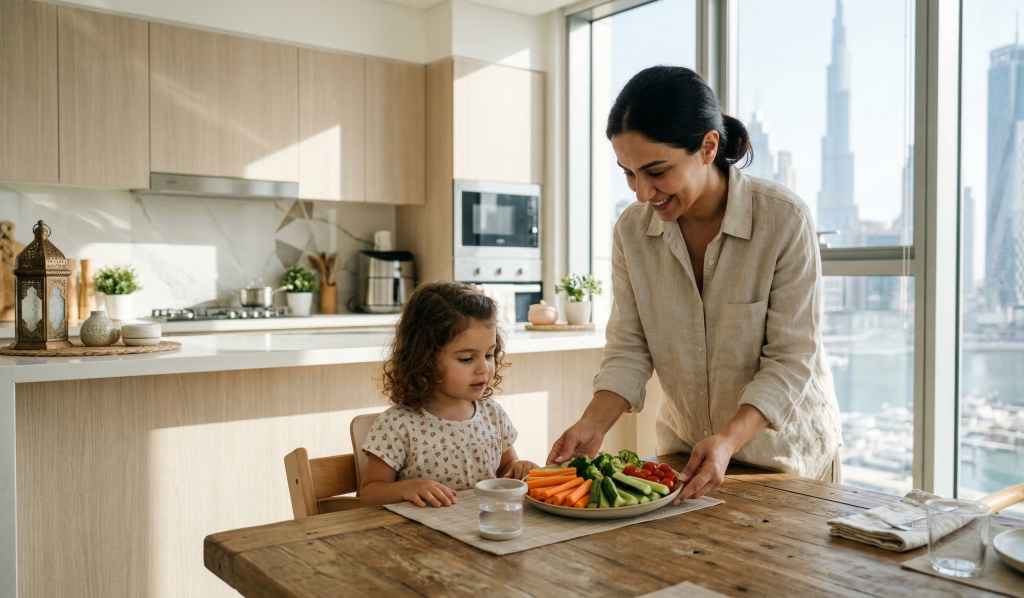
Here are practical adjustments that families in Dubai have found sustainable over time.
1. Use Simple Cooking Methods That Preserve Flavor
Avoid over-processing vegetables.
Instead:
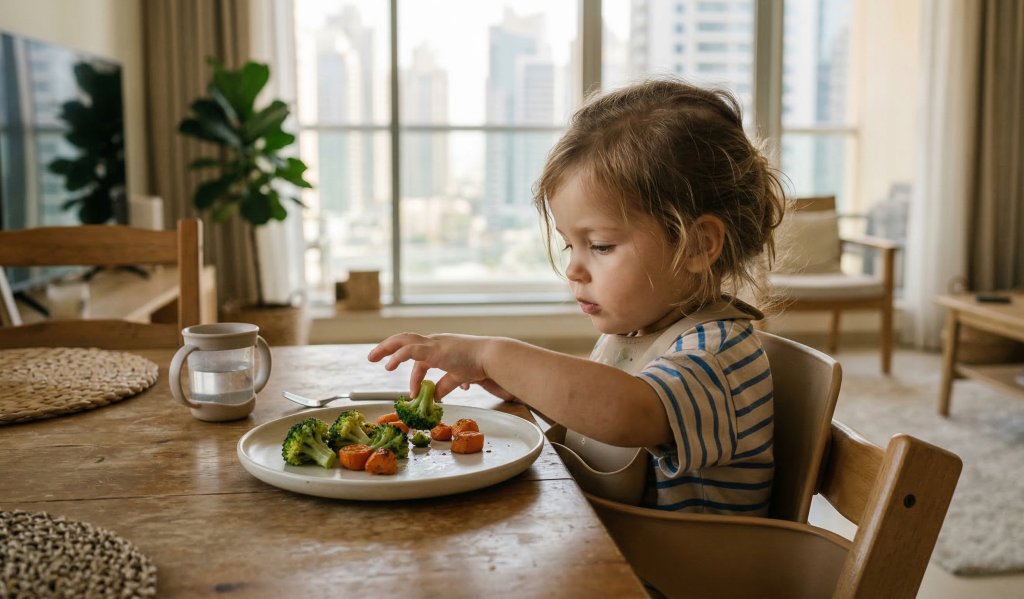
- Roast carrots or broccoli to bring out natural sweetness
- Lightly sauté spinach instead of boiling it
- Serve cucumbers and peppers raw for texture
These methods maintain the vegetable’s natural taste, which is easier for children to understand and accept.
2. Keep Portions Small and Manageable
Large portions can feel overwhelming.
Start with:
- One or two pieces
- A small spoonful
The goal is exposure, not immediate acceptance.
3. Serve Vegetables in Predictable Formats
Children respond well to consistency.
For example:
- Always slice cucumbers the same way
- Keep carrot sticks uniform
- Use the same plate or bowl
This reduces uncertainty and builds familiarity.
4. Avoid “Last-Minute Additions”
Vegetables added at the end of a meal often get ignored.
Instead:
- Include them early in the meal
- Integrate them into the main dish
This gives them equal importance.
5. Respect Appetite Cycles
Not every meal will be successful.
Children may:
- Accept vegetables one day
- Refuse them the next
This is normal.
Consistency over weeks matters more than individual meals.
Reducing Waste While Improving Acceptance
One concern often raised by families is waste.
Vegetables that are rejected frequently end up being discarded.
Why Waste Happens
- Buying too many varieties at once
- Poor storage at home
- Inconsistent cooking methods
- Changing vegetables too frequently
A More Efficient Approach
- Buy smaller quantities more frequently
- Focus on a few reliable vegetables
- Store produce properly (cool, dry, separated where needed)
These habits are similar to how professional kitchens manage inventory—minimizing loss while maintaining quality.
Storage Mistakes That Affect Taste
Even fresh vegetables can lose appeal if stored incorrectly.
Common Issues
- Leafy greens wilting due to moisture loss
- Herbs becoming slimy from excess humidity
- Root vegetables drying out
Simple Fixes
- Use breathable storage for greens
- Keep vegetables separate from fruits that release ethylene gas (like bananas)
- Avoid overpacking refrigerators
Better storage leads to better texture—and better acceptance from children.
Understanding the Time Factor
Vegetables are highly time-sensitive.
From the moment they are harvested, quality begins to change.
What This Means at Home
- Delaying use reduces freshness
- Longer storage increases bitterness or softness
- Reheating multiple times affects texture
Practical Habit
Plan meals around when vegetables are freshest, not just when it is convenient.
This is a small shift, but it has a noticeable impact on how vegetables taste.
The Long-Term View: Building Food Acceptance, Not Forcing It
One of the most consistent insights from nutritionists is this:
Children do not need to love vegetables immediately.
They need to become familiar with them.
What Progress Actually Looks Like
Week 1: Child refuses
Week 2: Child touches or smells
Week 3: Child tastes briefly
Week 4+: Gradual acceptance
This progression is normal.
Trying to skip steps often leads to resistance.
Where Supply Consistency Quietly Supports Parenting
While parenting habits play a central role, consistent sourcing supports the process.
In practice, suppliers working within Dubai’s structured distribution networks—including those aligned with established providers such as JMB Farm Fresh—often emphasize batch consistency.
This means:
- Similar taste across purchases
- Predictable cooking results
- Reduced variability in texture
For families, this reduces one of the biggest hidden challenges: unpredictability.
A Balanced Perspective on Improving Children’s Diets
It is important to avoid extremes.
What Works
- Consistent exposure
- Reliable quality
- Simple preparation
- Calm, pressure-free environment
What Often Fails
- Constantly changing strategies
- Overcomplicated recipes
- Forcing or negotiating
- Ignoring freshness and sourcing
Improving kids eating vegetables UAE is not about a single method.
It is about aligning small, repeatable habits over time.
Conclusion
Children refusing vegetables is rarely about stubbornness or poor parenting.
In Dubai, it is often a combination of:
- Inconsistent exposure
- Variable produce quality
- Changing meal patterns
- Misunderstood expectations
By focusing on:
- Familiarity
- Consistency
- Freshness
- Simplicity
Families can gradually improve acceptance without stress or pressure.
The goal is not perfection.
It is progress that lasts.
Frequently Asked Questions (FAQ)
1. Why do children in Dubai often refuse vegetables?
Many children lack consistent exposure. Variations in produce quality and meal routines also affect acceptance, making vegetables feel unfamiliar.
2. Are fresh vegetables really better for kids than stored ones?
Yes. Fresher vegetables usually have better texture and taste, which makes them easier for children to accept.
3. How often should I offer vegetables to my child?
Daily exposure is ideal. Even small portions help build familiarity over time.
4. Is it okay to hide vegetables in food?
It can help with nutrition, but children should also see and recognize vegetables to build long-term acceptance.
5. What vegetables are easiest for picky eaters in the UAE?
Mild options like carrots, cucumbers, zucchini, and spinach are usually easier to introduce due to their softer flavors.








 Home
Home  Whishlist
  Compare
  Checkout