




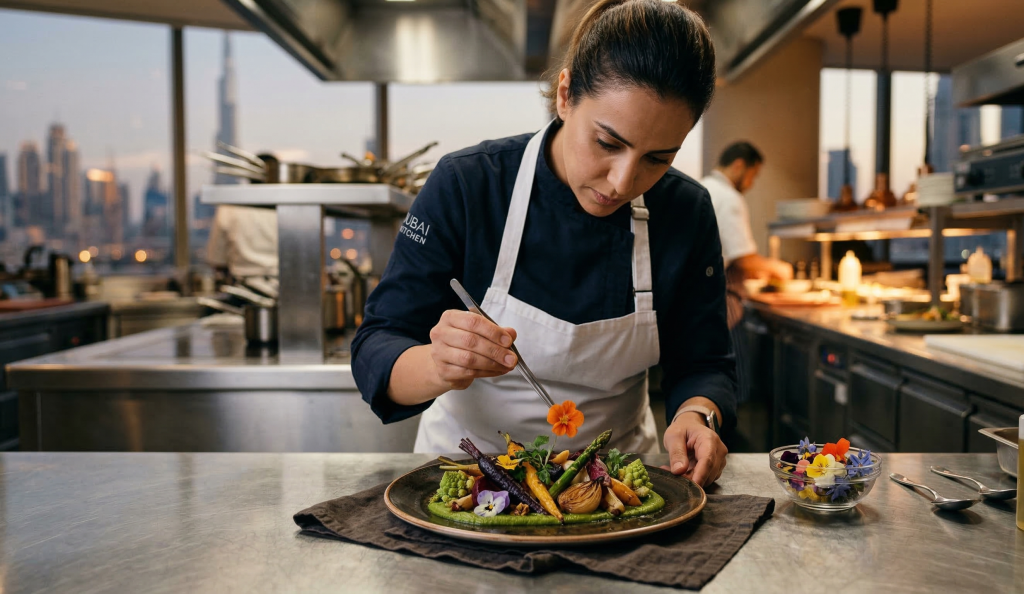
In many of Dubai’s most memorable dining experiences, the dish arrives at the table looking almost too beautiful to eat.
A delicate violet on a citrus salad.
Tiny marigold petals scattered across grilled vegetables.
A bright nasturtium leaf resting beside seared seafood.
For many diners, these details feel artistic. But in professional kitchens, they serve a practical purpose: visual balance, aroma, and subtle flavor contrast.
Edible flowers have quietly become part of modern food plating across Dubai’s hospitality scene — from fine-dining restaurants in Downtown to boutique cafés and home cooks experimenting with presentation.
Yet outside restaurant kitchens, many people still hesitate to use them. Common questions come up:
- Are edible flowers safe to cook with?
- Do they actually taste good or are they just decoration?
- Where do chefs source them in Dubai’s produce supply chain?
- And how should they be stored or used without ruining a dish?
Understanding how chefs approach edible flowers helps answer these questions. More importantly, it shows that using flowers in food is less about luxury and more about thoughtful presentation and seasonal produce awareness.
Why Edible Flowers Are Appearing More Often in Dubai Kitchens
Dubai’s dining scene is heavily influenced by global culinary trends. Over the past decade, chefs arriving from Europe, Japan, Australia, and the Middle East have brought plating styles that treat vegetables, herbs, and flowers as visual ingredients.
This shift is partly aesthetic, but there are practical reasons behind it.
1. The rise of visual dining
Restaurants today operate in an environment where dishes are photographed constantly.
Guests share plates on social media, and presentation plays a role in how memorable a meal becomes. Edible flowers offer natural color without artificial ingredients.
Unlike sauces or food coloring, flowers provide:
- organic color variation
- natural shapes
- seasonal visual elements
For chefs, they become a simple way to elevate a plate without changing the core recipe.
2. Dubai’s access to imported specialty produce
Dubai’s food supply chain is unusually global.
Wholesale produce markets and distributors regularly import specialty vegetables, microgreens, and edible flowers from:
- the Netherlands
- Kenya
- Thailand
- Italy
- regional farms in the UAE
This supply network makes it easier for restaurants to experiment with ingredients that might be harder to source elsewhere.
In practice, suppliers working closely with Dubai-based distributors such as JMB Farm Fresh often observe increasing interest from restaurants requesting small, delicate produce items like micro herbs, baby vegetables, and edible flowers.
These items are rarely the main ingredient in a dish, but they influence how the finished plate looks and feels.
3. A growing interest in natural plating
Modern chefs increasingly avoid artificial garnishes.
Instead of decorative plastic picks or processed garnishes, they prefer ingredients that are edible and natural.
Edible flowers fit this approach well.
They bring color while remaining part of the food itself — not just decoration.
What Exactly Are Edible Flowers?
Not all flowers are safe to eat.
Some flowers are toxic, while others are completely edible and widely used in cooking traditions around the world.
Edible flowers are simply flowers grown specifically for culinary use, usually without pesticides and harvested carefully to preserve flavor and appearance.
Many cultures have used them for centuries:
- Middle Eastern desserts often include rose petals or orange blossom.
- Japanese cuisine uses chrysanthemum leaves and blossoms.
- European kitchens frequently use violets, pansies, and marigolds.
Dubai’s multicultural food scene naturally blends these traditions.
The Edible Flowers Most Commonly Used in Dubai
Professional kitchens tend to favor flowers that are stable during transport, visually distinctive, and mild in flavor.
Here are some of the most common ones seen across restaurants and catering kitchens in the UAE.
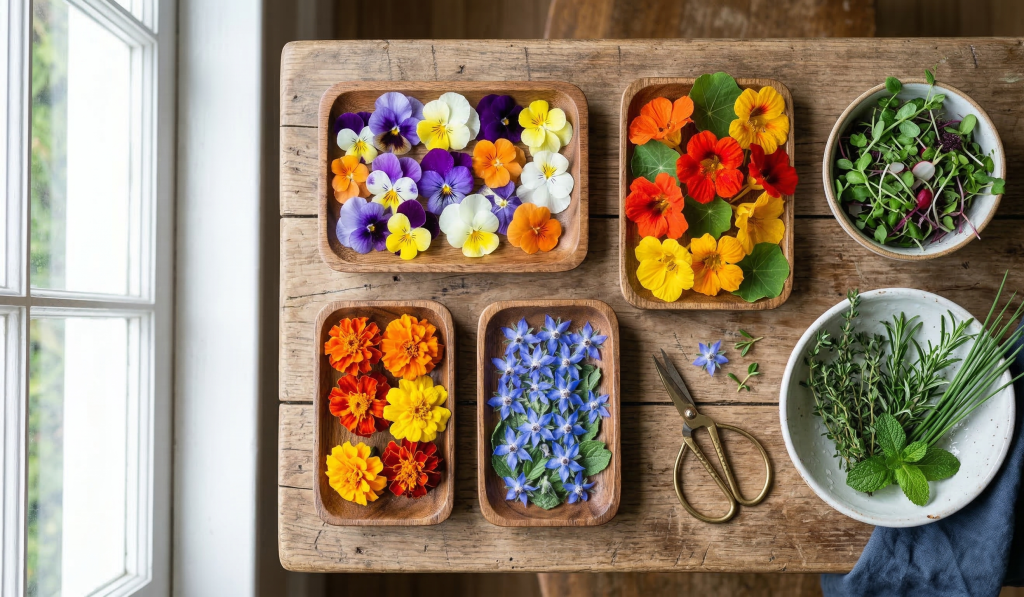
Nasturtium


4
Nasturtiums are one of the most recognizable edible flowers used in food plating.
They are known for:
- bright orange, yellow, or red petals
- round leaves that resemble lily pads
- a mild peppery flavor similar to watercress
Because of this flavor, chefs often pair nasturtiums with:
- salads
- grilled vegetables
- seafood dishes
- avocado or citrus plates
The leaves themselves are edible and frequently used in plated salads.
Pansies and Violas


4
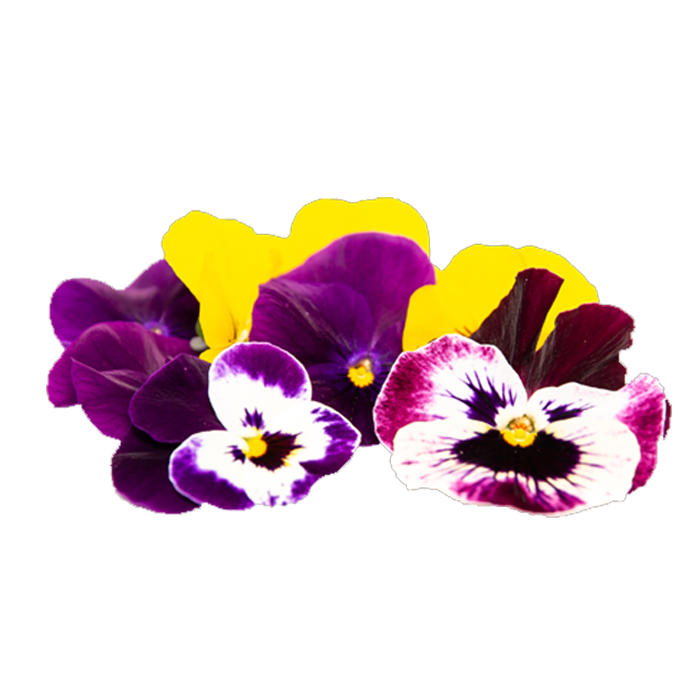
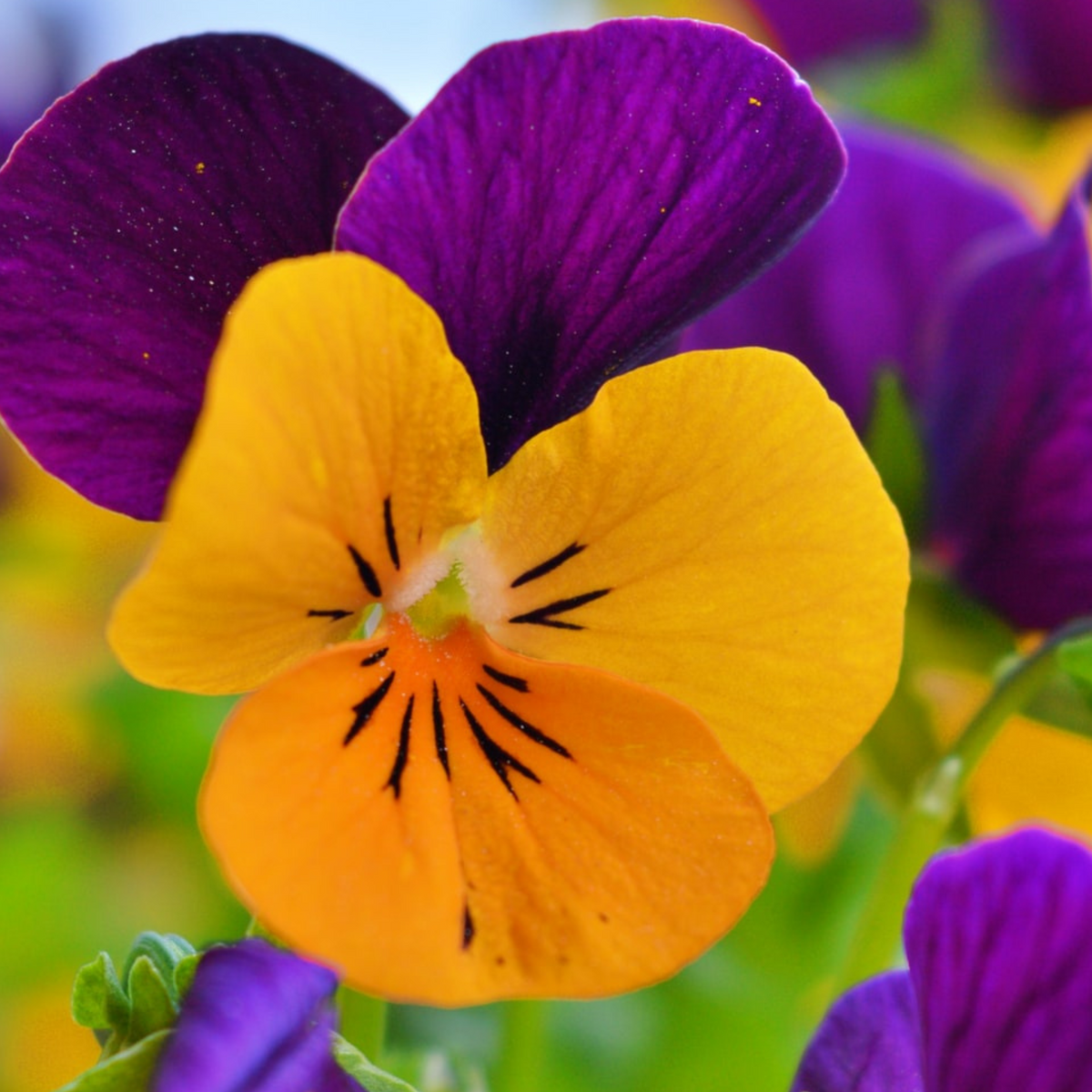
Pansies and violas are widely used because they hold their shape well after harvest.
Their main advantage is visual variety.
They come in colors such as:
- deep purple
- yellow
- white
- blue
- mixed color patterns
Chefs use them frequently on:
- desserts
- plated pastries
- fruit salads
- cheese boards
Their taste is extremely mild, which makes them suitable for both sweet and savory dishes.
Marigold Petals


4
Marigold petals add bright color to food and are often used in small quantities.
Instead of placing the whole flower on a plate, chefs typically separate the petals and scatter them lightly.
This works well on:
- grain bowls
- vegetable dishes
- soups
- rice plates
In some cuisines, marigold petals are even called “the poor man’s saffron” because they add color similar to saffron threads.
Borage


4
Borage flowers are small, star-shaped, and usually bright blue.
They have a light cucumber-like flavor.
Because of this, chefs often use them with:
- seafood
- cucumber salads
- cold soups
- cocktails
Their striking blue color makes them one of the most visually distinctive edible flowers.
Do Edible Flowers Actually Affect Flavor?
In most cases, their flavor is subtle.
Edible flowers are rarely used to dominate a dish. Instead, they add:
- mild herbal notes
- gentle bitterness
- fresh aromas
Some flowers — such as nasturtium or chive blossoms — have stronger flavors. Others are almost neutral.
Professional chefs usually treat them as accent ingredients, similar to herbs.
The goal is balance rather than intensity.
Are Edible Flowers Safe to Eat?
This is one of the most common concerns.
The key rule is simple:
Only eat flowers grown specifically for culinary use.
Flowers from florists or garden centers often contain pesticides or preservatives and should never be used in cooking.
Culinary edible flowers are:
- grown without harmful sprays
- harvested carefully
- packaged for food use
In Dubai, many are supplied through specialty produce distributors that also provide microgreens and herbs to restaurants.
Why Chefs Use Flowers for Food Plating
Presentation is rarely about decoration alone.
Good plating helps diners understand the dish before the first bite.
Edible flowers contribute in several ways:
Color contrast
A pale dish can feel more balanced with a small pop of color.
Natural texture
Petals and leaves create visual layers.
Seasonal storytelling
Flowers can reflect the season in which the produce was harvested.
Even small details like these can make a plate feel thoughtful rather than rushed.
In the next section, we will explore how chefs actually cook with edible flowers, not just garnish dishes — including simple techniques used in Dubai kitchens and common mistakes people make when experimenting at home.
Cooking With Edible Flowers: Techniques Used in Professional Kitchens
Many people assume edible flowers are only placed on a finished plate. In reality, chefs often integrate them into the cooking process in subtle ways.
This approach prevents flowers from feeling decorative or unnecessary. Instead, they become part of the flavor structure of the dish.
Below are several methods commonly used in Dubai kitchens.
Infusing Flavor Into Oils and Syrups
One of the simplest ways to use edible flowers is infusion.
Chefs often place fresh petals into neutral oil, honey, or simple syrup and allow them to steep gently. This transfers aroma without overwhelming the dish.
Common examples include:
- Rose or lavender syrup for desserts and beverages
- Marigold-infused oil for light vegetable dishes
- Chamomile syrup used in tea-based desserts
The key rule is temperature control. Too much heat can destroy the delicate aromas.
Most chefs prefer slow infusion at low temperature or room temperature.
Folding Petals Into Fresh Dishes
Some flowers work best when added just before serving.
This method preserves their color and texture.
You will often see petals folded into:
- green salads
- fruit bowls
- yogurt dishes
- cold pasta salads
Because edible flowers are delicate, they should rarely be tossed aggressively.
Instead, chefs gently place them within the dish to maintain their shape.
Freezing Flowers Into Ice
This technique is popular in cafés and catering events across Dubai.
Flowers such as violets or borage can be frozen inside ice cubes. The result is a drink that gradually reveals color as the ice melts.
Restaurants often use this for:
- lemonade
- sparkling water
- mocktails
- summer beverages
The process is straightforward:
- Place a small flower inside an ice tray.
- Fill halfway with filtered water.
- Freeze partially.
- Add the remaining water and freeze again.
This prevents the flower from floating to the top.
Baking With Edible Flowers
Some flowers hold their structure well in baked goods.
Examples include:
- lavender in cakes
- rose petals in pastries
- calendula in bread or biscuits
However, restraint matters.
Too many petals can introduce bitterness or overpower a dessert.
Professional bakers usually treat flowers like spices — used sparingly.
The Difference Between Garnish and Plate Design
A common misunderstanding is that edible flowers automatically improve a dish.
In reality, poorly placed flowers can make a plate look cluttered or forced.
Professional chefs follow a simple plating philosophy: every element must have a purpose.
Flowers usually play one of three roles.
1. Color balance
If a dish is visually monotone — for example, beige grains or pale vegetables — a small flower can create contrast.
2. Visual movement
Petals scattered lightly across a plate guide the eye around the dish.
This helps a plate feel dynamic rather than flat.
3. Ingredient storytelling
In vegetable-forward dishes, flowers can visually represent the plant itself.
For example, a dish featuring squash may include squash blossoms.
This technique subtly reminds diners where the ingredient originates.
Simple Flower Garnish Recipes Used in UAE Kitchens
Below are several approachable ideas that reflect how edible flowers are used in both restaurant kitchens and home cooking.
These recipes are intentionally simple so that the flowers enhance the dish rather than dominate it.
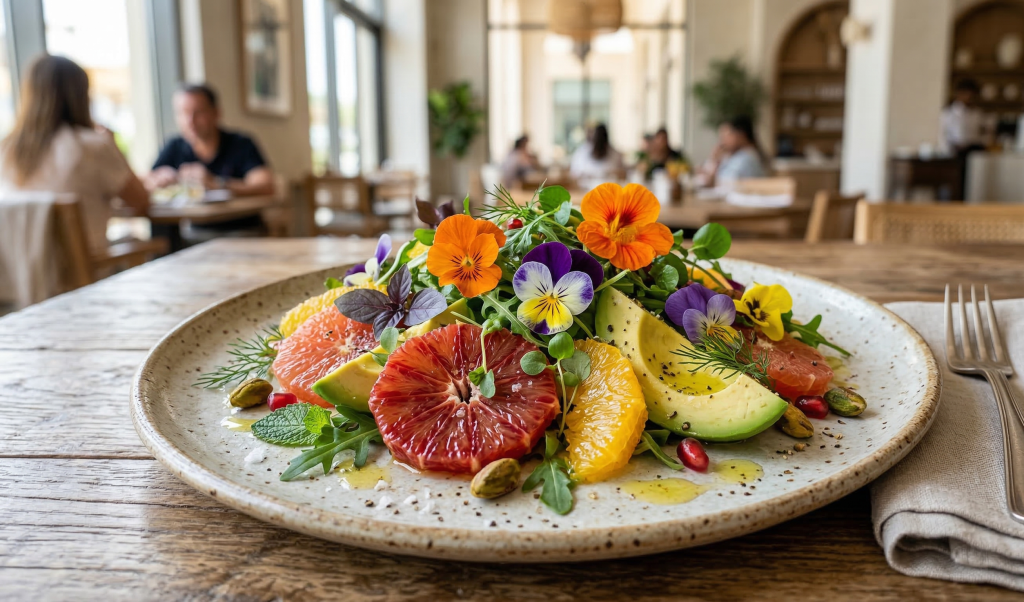
Citrus Salad With Nasturtium
A common style in Dubai cafés combines citrus fruits with peppery greens.
Ingredients
- orange slices
- grapefruit segments
- arugula
- olive oil
- sea salt
- nasturtium flowers and leaves
Method
Arrange citrus segments across the plate, add arugula lightly, and place a few nasturtium flowers across the top.
The peppery flavor of nasturtium complements citrus acidity surprisingly well.
Yogurt Bowl With Edible Flowers
This dish appears frequently in boutique cafés.
Ingredients
- thick yogurt
- honey
- fresh berries
- pistachios
- edible pansies
Method
Spread yogurt in a bowl, drizzle honey, add berries and pistachios, then gently place pansies across the surface.
The flowers add color without altering the flavor significantly.
Herb Rice With Marigold Petals
Marigold petals are often used in Middle Eastern-inspired rice dishes.
Ingredients
- basmati rice
- fresh herbs (parsley, mint)
- olive oil
- lemon zest
- marigold petals
Method
Cook rice normally, mix in herbs and lemon zest, then sprinkle a few marigold petals on top before serving.
The petals add color similar to saffron but with a lighter aroma.
Where Edible Flowers Come From in Dubai’s Produce Supply Chain
Unlike herbs or leafy greens, edible flowers require careful handling.
They are fragile and have a short shelf life.
Because of this, they often move through the produce supply chain differently than regular vegetables.
Most edible flowers available in the UAE come from two main sources.
Imported specialty farms
Many edible flowers arrive from European or African farms that specialize in microgreens and specialty produce.
These farms grow flowers specifically for culinary use and ship them in small refrigerated containers.
Regional greenhouse growers
In recent years, greenhouse farms in the UAE have begun growing specialty herbs, microgreens, and flowers locally.
Local production helps reduce transport time and improves freshness.
The Shelf Life Challenge
One issue buyers often encounter is shelf life.
Edible flowers typically last three to five days after harvest.
Temperature, humidity, and packaging all affect longevity.
Restaurants usually order them in small quantities several times per week rather than storing large amounts.
For households experimenting with edible flowers, the best approach is similar:
- purchase small quantities
- store them in refrigeration
- use them within a few days
Trying to stretch their lifespan usually leads to wilted petals.
Common Mistakes When Cooking With Edible Flowers
Even experienced cooks sometimes struggle when first experimenting with flowers in food.
Several patterns appear frequently.
Using too many flowers
Flowers are accent ingredients.
A dish covered entirely in petals often looks chaotic and tastes unbalanced.
Ignoring flavor compatibility
Some flowers have subtle bitterness or herbal notes.
Pairing them with the wrong ingredients can clash with the dish.
Washing them incorrectly
Flowers should be rinsed gently in cold water and dried carefully.
Aggressive washing can damage petals.
Treating them as decoration only
When flowers relate to the flavors of the dish, they feel intentional rather than ornamental.
In the final section, we will explore how households and small catering businesses in Dubai can source edible flowers responsibly, how seasonal availability affects supply, and practical guidance for using them without increasing food waste.
How Households and Small Catering Businesses in Dubai Source Edible Flowers
For restaurants with established supply chains, sourcing edible flowers is usually straightforward. Many work with specialty produce distributors who deliver microgreens, herbs, and delicate garnishes several times per week.
For households and small catering businesses, however, the process can feel less clear.
Unlike common vegetables or herbs, edible flowers are not widely stocked in standard supermarkets. They are typically sourced through specialty produce suppliers, boutique grocers, or online fresh produce platforms that focus on restaurant-grade ingredients.
These suppliers usually package flowers in small containers to prevent damage during transport.
When buyers search for options like buy edible flowers Dubai online or edible flower delivery UAE, they are usually discovering these same professional supply channels that restaurants rely on.
The important point is not where the flowers are purchased but how they are handled after purchase.
How to Judge Freshness When Buying Edible Flowers
Freshness matters more for edible flowers than almost any other produce item.
Because petals are thin and delicate, even small changes in temperature or humidity can affect quality.
When evaluating flowers, chefs and produce buyers usually look for several indicators.
Signs of good quality
- petals are vibrant and upright
- colors appear saturated rather than faded
- stems are slightly moist but not wet
- the container shows no condensation or bruising
Signs of declining freshness
- petals curling inward
- dark spots or discoloration
- excessive moisture inside packaging
- wilted stems
A good rule is to use flowers within a few days of purchase.
Professional kitchens rarely hold them longer.
Storage Tips Used in Restaurant Kitchens
Proper storage can extend the usable life of edible flowers slightly.
Most chefs follow a few simple guidelines.
Keep flowers refrigerated
Temperatures between 2–5°C help maintain structure and color.
Avoid sealed plastic bags
Flowers need airflow. Fully sealed containers can trap moisture and accelerate spoilage.
Use a dry container with paper lining
Some kitchens place a paper towel inside the container to absorb excess humidity.
Handle only when necessary
Frequent handling can bruise petals.
Seasonal Availability of Edible Flowers in the UAE
Seasonality affects edible flower availability just as it does vegetables and fruits.
While imports allow year-round supply, certain flowers appear more frequently during cooler months.
Winter season (November–March)
This period aligns with peak vegetable harvests in the UAE and nearby regions.
Local farms are more likely to produce:
- nasturtiums
- marigolds
- calendula
- herb blossoms
Because temperatures are moderate, greenhouse production becomes more stable.
For chefs and catering businesses, winter is often the easiest season to source flowers with consistent quality.
Warmer months (April–October)
During hotter months, local production becomes more challenging.
Many edible flowers are imported from controlled environments overseas.
This can sometimes result in:
- slightly higher prices
- shorter shelf life after delivery
- limited variety
Restaurants often adjust plating styles during these months, relying more on herbs or microgreens instead.
Wholesale vs Retail Buying: What Buyers Often Misunderstand
In discussions among restaurant operators and food buyers, a common misconception appears repeatedly.
Many assume that wholesale produce — including edible flowers — must be lower quality because it is sold in larger quantities.
In reality, the opposite is often true.
Wholesale suppliers typically source produce directly from farms or import partners, which means the product has often moved through fewer handling stages.
Retail produce, by contrast, may pass through several storage environments before reaching store shelves.
That said, wholesale buying does involve tradeoffs.
Advantages of wholesale sourcing
- fresher deliveries when supply chains are efficient
- access to specialty produce not available in supermarkets
- more predictable supply for restaurants or events
Limitations
- minimum order quantities may apply
- shelf life management becomes the buyer’s responsibility
- smaller households may not use quantities quickly enough
For this reason, many home cooks prefer purchasing small containers through online specialty produce retailers rather than bulk wholesale.
Some UAE buyers choose established distributors rather than fragmented retail sourcing when they need consistent specialty produce for events or hospitality service.
Why Edible Flowers Are Popular in Dubai’s Catering Scene
Catering companies frequently use edible flowers for practical reasons.
Large buffet presentations require dishes that look appealing even before guests begin serving themselves.
Flowers offer several advantages in this context:
- they add color without requiring complicated preparation
- they photograph well for event documentation
- they create visual distinction between dishes on large buffet tables
For example, a simple platter of roasted vegetables can look significantly more refined when finished with a few carefully placed petals or herb blossoms.
The underlying food remains simple, but presentation improves.
A Practical Approach for Home Cooks
For households experimenting with edible flowers, the key is to keep expectations simple.
Start with dishes that already look colorful and fresh.
Examples include:
- fruit salads
- yogurt bowls
- vegetable platters
- simple desserts
Instead of covering a dish with flowers, try using two or three small blooms placed thoughtfully.
This mirrors the restraint used in professional kitchens.
Over time, it becomes easier to recognize which flowers complement particular ingredients.
Why Edible Flowers Reflect a Broader Produce Trend
The popularity of edible flowers reflects a wider shift in how people think about fresh produce.
Instead of focusing only on major ingredients — tomatoes, cucumbers, or leafy greens — chefs increasingly treat every part of the plant as a potential culinary element.
Flowers represent one example of this philosophy.
They remind diners that vegetables, herbs, and fruits originate from living plants with multiple edible components.
This perspective is becoming more visible across Dubai’s restaurant culture, where presentation, freshness, and ingredient storytelling often go hand in hand.
Conclusion
Edible flowers may appear delicate, but their role in modern cooking is surprisingly practical.
They provide natural color, subtle flavor, and visual balance without requiring complicated preparation. When used thoughtfully, they can transform even simple dishes into something memorable.
Dubai’s diverse food supply chain has made these ingredients more accessible than ever — not only for restaurants but also for households interested in experimenting with plating and presentation.
The key is restraint.
Professional chefs rarely use large quantities. Instead, they place a few carefully chosen flowers where they add the most visual and culinary impact.
Understanding how to source, store, and use edible flowers responsibly allows both home cooks and hospitality professionals to explore this ingredient without unnecessary waste.
In the end, edible flowers are less about decoration and more about respecting the beauty and versatility of fresh produce.
FAQ Section
1. What are edible flowers used for in cooking?
Edible flowers are used to enhance food presentation, add subtle flavor, and introduce natural color to dishes. They are commonly used in salads, desserts, drinks, and plated vegetable dishes in both restaurant kitchens and home cooking.
2. Where can people buy edible flowers in Dubai?
Edible flowers are usually available through specialty produce suppliers, gourmet grocers, or online fresh produce delivery platforms in the UAE. These suppliers often serve restaurants as well as households interested in culinary ingredients.
3. Are all flowers safe to eat?
No. Only flowers grown specifically for culinary use should be eaten. Flowers from florists or garden centers may contain pesticides or preservatives and should not be used in cooking.
4. How long do edible flowers last after purchase?
Most edible flowers remain fresh for about three to five days when stored in refrigeration. Proper storage with airflow and low humidity can help preserve their appearance.
5. Do edible flowers change the flavor of food?
Some flowers add mild herbal or peppery notes, while others are almost neutral in taste. In most dishes, they are used primarily for visual presentation rather than strong flavor.








 Home
Home  Whishlist
  Compare
  Checkout