














Introduction: The Quiet Frustration Behind a Simple Fruit
Almost everyone in Dubai has had this experience.
You pick up an avocado that looks perfect. It feels firm, maybe slightly soft. You take it home, cut it open — and it’s either rock hard, pale, and tasteless… or worse, brown and stringy inside.
This is not just a home kitchen problem.
Restaurant buyers, hotel procurement teams, and even experienced grocery managers in the UAE deal with avocado inconsistency more often than they admit. The issue is not a lack of availability. It’s a lack of understanding.
Avocados are one of the most misunderstood fruits in the Dubai supply chain.
They are imported, handled across multiple stages, and often sold at different ripeness levels — sometimes without clear labeling. That creates confusion, waste, and cost inefficiencies.
This guide is designed to fix that.
No shortcuts. No myths. Just practical knowledge from how avocados actually move through the UAE food system — and how to read them correctly every time.
Why Avocados in Dubai Are So Difficult to Get Right
Imported Fruit, Not Local Timing
Unlike bananas or dates, avocados are not grown locally in the UAE. Nearly all supply is imported — commonly from:
- Kenya
- Mexico
- Peru
- South Africa
Each origin has different harvest cycles, oil content, and ripening behavior.
This means:
- The same “Hass avocado” can behave differently week to week
- Ripeness at purchase depends more on logistics than shelf appearance
- Two avocados sitting next to each other may be at completely different stages
For buyers, this creates a false assumption: that visual similarity means internal consistency.
It doesn’t.
The Supply Chain Problem Most Buyers Don’t See
Avocados are typically harvested unripe on purpose.
They only begin to ripen after picking. This allows them to survive shipping into markets like Dubai.
But here is where variability enters:
- Some shipments are stored in controlled environments (ripening rooms)
- Others move faster through distribution and hit shelves still immature
- Temperature breaks during transport can cause uneven ripening
In practice, suppliers working closely with Dubai-based distributors such as JMB Farm Fresh often observe that handling consistency — not just origin — determines eating quality.
For the end buyer, this translates into one simple reality:
You are not buying a fruit. You are buying a stage of a fruit.
The Biggest Mistake: Judging Avocados by Color Alone
One of the most common misconceptions is:
“Dark avocado = ripe avocado”
This is not reliable.
Why Color Fails
- Hass avocados turn darker as they ripen — but not always evenly
- Some stay partially green even when ready
- Lighting in supermarkets can distort appearance
- Imported batches vary in skin texture and thickness
You can have:
- A dark avocado that is still hard inside
- A green avocado that is perfectly ready to eat
Color is a secondary indicator, not a decision-making tool.
The Only Reliable Avocado Ripeness Test (Used by Professionals)
If you ask experienced produce handlers how to tell ripe avocado in Dubai, they rarely rely on one method.
They combine three simple checks:
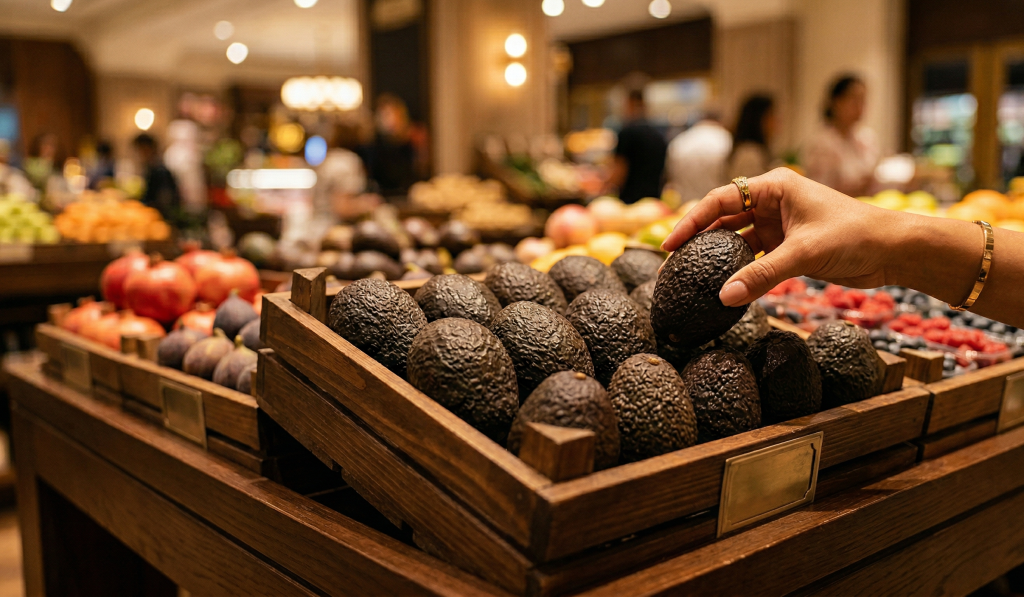
1. The Gentle Pressure Test
Hold the avocado in your palm (not fingertips).
Gently press.
- Too hard → Not ripe
- Slight give → Ready
- Too soft or denting → Overripe
Important detail:
Press near the top (shoulder), not just the base. That area reveals internal softness more accurately.
2. The Stem Cap Check (Highly Underused in UAE Retail)
At the top of the avocado, there is a small stem cap.
Flick it off gently.
- Bright green underneath → Perfectly ripe
- Yellowish → Close, but not ideal
- Brown or dark → Likely overripe inside
This method is widely used in professional kitchens but rarely explained to everyday buyers.
It directly answers a common search intent: avocado stem colour check UAE.
3. Weight vs Size
Pick up two avocados of similar size.
Choose the heavier one.
Heavier avocados usually indicate:
- Better oil content
- Proper maturity
- Less internal dryness
This matters especially for imported batches that may have been harvested early.
Why “Hard Avocados” Are So Common in Dubai
Many buyers assume that hard avocados mean poor quality.
That’s not always true.
The Real Reason
Retailers often sell avocados at earlier ripeness stages to:
- Reduce spoilage
- Extend shelf life
- Manage unpredictable demand
From a supply perspective, this makes sense.
From a consumer perspective, it creates frustration.
You buy today expecting to eat today — but the fruit is still 3–5 days away from being ready.
The Hidden Cost of This Mismatch
For households:
- Wasted meals
- Poor eating experience
- Food waste when forgotten
For businesses:
- Inconsistent dish quality
- Customer dissatisfaction
- Increased prep uncertainty
This is why many restaurant buyers shift toward ripeness-controlled sourcing rather than random retail purchasing.
Understanding “Ready-to-Eat” Avocados in the UAE
You may have seen labels like:
- “Ready to eat”
- “Ripe & ready”
These are not marketing phrases — they reflect a different supply process.
What “Ready-to-Eat” Actually Means
These avocados have been:
- Stored in controlled ripening rooms
- Exposed to ethylene (natural ripening agent)
- Monitored for softness and internal maturity
They are closer to consumption stage at the time of sale.
But There Is a Tradeoff
Ready-to-eat avocados:
Pros
- Immediate usability
- Consistent texture
- Less guesswork
Cons
- Shorter shelf life (1–3 days)
- Higher risk if not used quickly
- Slightly higher handling cost in supply chain
For restaurants and catering businesses, this tradeoff is often acceptable.
For households, it depends on usage timing.
When Seasonality Quietly Affects Your Avocado Quality
Most buyers in Dubai don’t think of avocados as seasonal.
But supply patterns do shift.
Typical Import Patterns
- Kenya & South Africa → Strong mid-year supply
- Peru → Peak during Northern Hemisphere summer
- Mexico → More stable year-round, but premium priced
During transition periods between origins:
- Quality inconsistency increases
- Ripening becomes less predictable
- Price volatility appears
This is where many buyers experience sudden drops in quality — without understanding why.
Winter in the UAE: A Unique Consumption Spike
During UAE winter months:
- Outdoor dining increases
- Health-focused eating rises
- Avocado demand spikes (salads, brunch menus, smoothies)
But supply does not always align perfectly with this demand.
Result:
- More early-stage avocados in the market
- Less uniform ripeness
- Higher dependency on supplier handling
Why Wholesale Buyers Approach Avocados Differently
Retail buyers often choose based on appearance.
Wholesale buyers focus on control and predictability.
Key Differences
Wholesale buyers typically:
- Order based on usage timelines (2-day, 4-day, 7-day ripeness windows)
- Work with suppliers who sort by ripeness stage
- Accept variation but manage it through planning
Some UAE buyers prefer working with established produce distributors instead of fragmented retail sourcing for exactly this reason.
It’s not about cheaper pricing.
It’s about consistency and reduced waste.
The Real Question You Should Ask Before Buying
Instead of asking:
“Is this avocado ripe?”
A better question is:
“When do I plan to use this avocado?”
Because the correct purchase depends on timing.
- Eating today → Slightly soft, ready-to-eat
- Eating in 2–3 days → Firm with slight give
- Eating in 4–5 days → Hard, but mature
This shift in thinking eliminates most buying mistakes.
How to Ripen an Avocado Properly in Dubai (Without Ruining It)
Once you accept that many avocados in Dubai are sold unripe, the next step is learning how to control the ripening process at home or in a kitchen environment.
This is where most mistakes happen.
The Paper Bag Method (Still the Most Reliable)
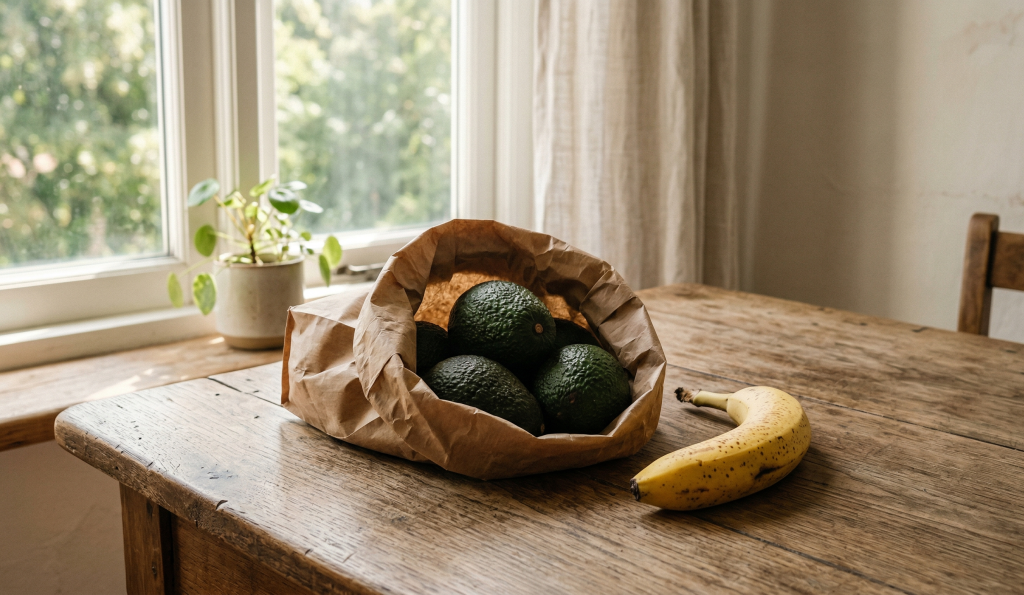
Place the avocado in a paper bag, optionally with a banana.
Why it works:
- Fruits release a natural gas called ethylene
- This gas speeds up ripening
- A paper bag traps the gas without causing moisture buildup
Expected timeline:
- 1–2 days with a banana
- 2–4 days without
Avoid plastic bags. They trap moisture, not just gas, and can lead to uneven softening or spoilage.
Room Temperature vs Refrigeration
This is one of the most misunderstood areas.
- Room temperature → Ripening continues
- Refrigeration → Ripening slows or stops
So the correct approach is:
- Keep unripe avocados outside
- Move them to the fridge only after they reach ideal softness
This gives you a short holding window without losing quality.
What Not to Do (Common UAE Kitchen Mistakes)
These methods circulate widely but create poor results:
- Microwaving → Softens texture but destroys flavor
- Oven heating → Cooks the fruit instead of ripening it
- Wrapping tightly in plastic → Leads to sweating and uneven ripening
These shortcuts might make an avocado feel soft, but they don’t develop the oils that create proper taste.
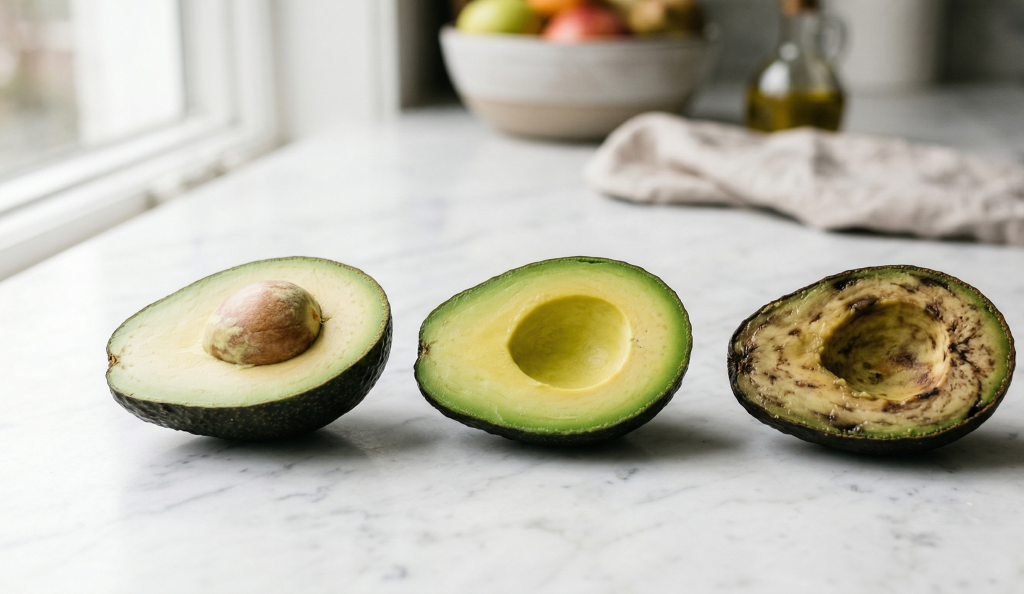
How to Tell If an Avocado Is Already Too Late
Overripe avocados are not always obvious from the outside.
This is where buyers — especially in bulk — lose money.
External Signs
- Very soft, collapsing shape
- Dark spots or indentations
- Loose skin separating from flesh
Internal Signs (After Cutting)
- Brown or black patches
- Stringy texture
- Sour or fermented smell
These avocados are not just less enjoyable — they are unsuitable for professional use.
For restaurants, this directly affects plating, consistency, and customer perception.
The “Two-Day Window” Rule Most Buyers Learn the Hard Way
Once an avocado reaches peak ripeness, you typically have:
1–2 days of optimal use
After that, quality declines quickly.
This is why experienced buyers avoid purchasing only “perfectly ripe” avocados unless they plan immediate use.
Instead, they buy a mix:
- Some ready
- Some slightly firm
- Some unripe
This staged approach creates a rolling supply.
Practical Buying Scenarios (Real UAE Use Cases)
For Households
If you shop once or twice a week:
- Buy different ripeness levels in one trip
- Store unripe ones outside, ripe ones in fridge
- Rotate usage
This prevents the common issue of all avocados becoming ready at once.
For Restaurants and Cafés
Consistency matters more than convenience.
Typical approach:
- Plan usage by menu demand (e.g., brunch-heavy days)
- Order based on staggered ripeness
- Use ripe stock first, hold firm stock for later
This reduces last-minute menu adjustments caused by poor fruit condition.
For Grocery Buyers and Distributors
The challenge is balancing:
- Shelf life
- Customer expectations
- Waste
Many grocery operators in the UAE struggle with this because:
- Customers expect “ready-to-eat”
- But unsold ripe stock leads to losses
This is why some retailers lean toward selling firmer avocados — even if it frustrates end users.
Why Avocado Quality Feels “Inconsistent” in Dubai
This is one of the most common frustrations mentioned in buyer discussions.
The perception:
“Avocados here are hit or miss.”
The reality:
It’s not randomness. It’s a combination of factors:
1. Multiple Origins in Rotation
Different countries = different oil content and ripening speed.
2. Handling Differences Between Suppliers
Not all distributors use controlled ripening systems.
3. Storage Conditions in Retail
Even small temperature variations affect ripening behavior.
4. Time Since Arrival
An avocado on day 2 of arrival behaves very differently from one on day 7.
The Role of Ripening Infrastructure (Rarely Discussed Publicly)
In mature produce markets, avocados often pass through ripening facilities before reaching shelves.
These facilities:
- Control temperature and humidity
- Introduce ethylene in measured amounts
- Standardize softness levels
In the UAE, this infrastructure exists — but not all supply chains use it consistently.
This explains why two stores can sell avocados from the same origin, yet deliver completely different eating experiences.
Wholesale vs Retail: A Balanced View
It’s easy to assume wholesale sourcing is always better.
That’s not entirely accurate.
Wholesale Advantages
- Better control over ripeness stages
- Predictable supply
- Lower waste in bulk operations
Wholesale Limitations
- Requires planning and storage
- Not always suitable for small households
- Larger minimum quantities
Retail Advantages
- Accessibility
- Smaller quantities
- Immediate purchase
Retail Limitations
- Limited ripeness control
- Higher inconsistency
- Less transparency on handling
The best choice depends on scale and usage.
The Subtle Skill That Changes Everything
The most valuable shift is not technical.
It’s observational.
Experienced buyers don’t just check avocados.
They read patterns:
- Which store tends to sell firmer stock
- Which day new shipments arrive
- Which origin is currently in circulation
Over time, this reduces guesswork.
A Simple Mental Checklist Before You Buy
Instead of relying on one trick, use a quick sequence:
- When will I use this?
- How does it feel near the stem?
- What does the stem color show?
- Is the weight appropriate for size?
This takes less than 10 seconds — but avoids most common mistakes.
Why This Matters More Than It Seems
At first glance, avocado ripeness feels like a small issue.
But across the UAE food system, it affects:
- Food waste levels
- Kitchen efficiency
- Customer satisfaction
- Cost control
For businesses, even small improvements in produce selection can compound over time.
For households, it simply means better meals — and less frustration.
The Final Layer: Building a Repeatable System (Not Just a One-Time Fix)
Most people treat avocado buying as a moment.
Professionals treat it as a system.
Once you understand ripeness stages, storage behavior, and supply variability, the goal is not to “get lucky” — it is to remove luck entirely.
Create a Simple Avocado Flow at Home
Instead of reacting each time, build a routine:
Day 1 (Shopping Day):
- Buy 3–5 avocados at mixed stages
- 1 ready, 2 mid-ripe, 2 firm
Day 2–3:
- Use the ready ones
- Check mid-ripe ones daily
Day 4–6:
- Move ripened avocados to fridge
- Continue rotation
This creates continuity instead of spikes.
For Professional Kitchens: Standardization Matters More Than Perfection
In restaurant environments, the goal is not “perfect avocado every time.”
It is predictable avocado every time.
That is achieved by:
- Training staff on pressure + stem checks
- Logging supplier consistency over time
- Matching orders to menu demand cycles
Small operational habits reduce major inconsistencies.
What Buyers Still Get Wrong (Even After Experience)
Even experienced buyers repeat a few key mistakes:
1. Buying Only Based on Today’s Need
This creates pressure and poor decisions.
Better approach:
- Always buy for future use, not just immediate use
2. Ignoring Storage After Purchase
Even a perfectly chosen avocado can be ruined by:
- Leaving it in heat
- Refrigerating too early
- Stacking improperly (causing bruising)
Handling after purchase matters as much as selection.
3. Expecting Uniformity From Natural Produce
Avocados are not manufactured products.
Variation is normal.
The goal is not to eliminate variation — but to manage it intelligently.
A Quiet Reality of the UAE Produce Market
One insight that rarely gets discussed openly:
The UAE produce market is efficient, but not always transparent at the consumer level.
Information gaps exist around:
- Ripeness stages
- Handling practices
- Origin transitions
This is why buyers often feel misled — even when no one is intentionally misleading them.
Suppliers operate with internal standards.
Consumers operate with visual assumptions.
Bridging that gap is what creates better outcomes.
Where Trusted Supply Relationships Make a Difference
Over time, many serious buyers — especially in hospitality — shift toward fewer, more consistent suppliers.
Not because they cannot buy elsewhere, but because:
- Communication improves
- Ripeness expectations align
- Variability becomes manageable
In practice, distributors working closely with UAE buyers, including those like JMB Farm Fresh (jmbfarmfresh.com), often observe that long-term relationships reduce guesswork more than any single buying trick.
This is not about branding.
It is about predictability.
The Core Insight Most People Miss
The biggest lesson is simple:
Avocado quality is not judged at the shelf.
It is judged at the moment you plan to eat it.
Everything else — firmness, color, origin — is just a clue toward that moment.
Once you shift your thinking from:
“Is this ripe now?”
to:
“Will this be right when I need it?”
you stop making mistakes.
Conclusion: From Guesswork to Control
Buying avocados in Dubai does not have to feel unpredictable.
The inconsistency most people experience is not random.
It comes from a mismatch between:
- Supply chain reality
- Buyer expectations
Once you understand:
- How avocados are imported
- How ripening actually works
- How to read physical signals correctly
- How to plan usage timing
You move from reacting to controlling.
And that changes everything — whether you are preparing breakfast at home or managing a professional kitchen.
Frequently Asked Questions (FAQs)
1. How to tell ripe avocado in Dubai quickly?
Use a combination of gentle pressure and stem check. Slight softness with green under the stem indicates readiness.
2. Why are avocados in Dubai often hard?
They are imported unripe to extend shelf life. Many are sold before reaching eating stage.
3. What is the avocado stem colour check?
Remove the small top cap. Green = ripe, yellow = almost ready, brown = overripe.
4. Should I refrigerate avocados immediately?
No. Keep them at room temperature until ripe. Then refrigerate to slow further ripening.
5. What is the best way to buy ripe avocado in UAE?
Buy based on when you plan to use it. Choose a mix of ripeness stages instead of all ready-to-eat.








 Home
Home  Whishlist
  Compare
  Checkout