











Introduction: A Simple Word with Many Meanings
“Fresh” is one of the most used—and least explained—words in the food business.
In Dubai, it appears everywhere: on supermarket shelves, wholesale invoices, restaurant menus, and supplier conversations. Everyone wants fresh fruits and vegetables in Dubai, yet buyers often mean different things when they say it.
For a home cook, fresh may mean bright color and firm texture.
For a restaurant, it may mean predictable shelf life and consistent cuts.
For a distributor, it often means temperature control, handling speed, and traceability.
This gap in understanding causes many of the frustrations buyers quietly deal with: short shelf life, unexpected spoilage, fluctuating prices, and produce that looks good but performs poorly in the kitchen.
This article breaks down what “fresh” actually means inside the produce supply chain in the UAE, using practical, non-technical language. The goal is not to sell anything, but to help buyers—whether families, chefs, or procurement teams—make better decisions and reduce waste.
Why “Fresh” Is Not a Fixed Standard in Dubai
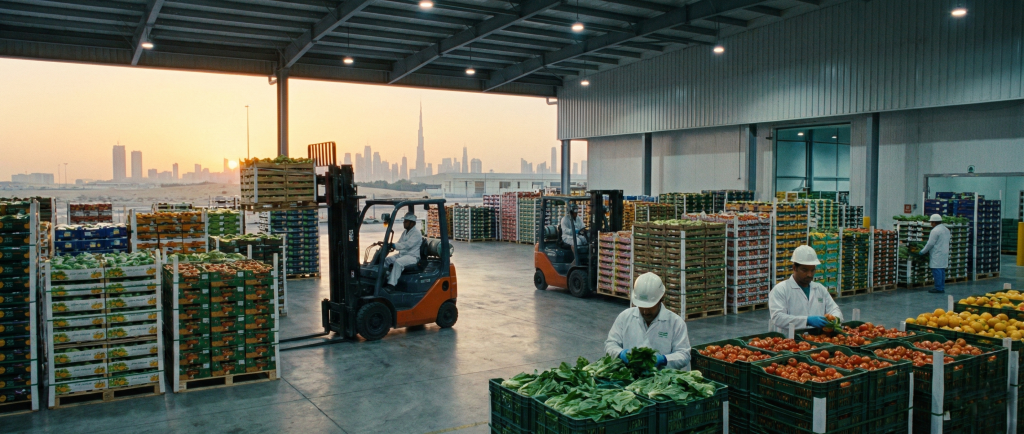
Dubai does not grow most of its fruits and vegetables. Freshness here is not just about harvest—it is about time, distance, and control.
A tomato harvested yesterday in another country may be “fresher” than one harvested locally a week ago if it was cooled, transported, and stored correctly.
In practice, freshness depends on four overlapping factors:
- Time since harvest
- Temperature control from farm to buyer
- Handling quality (packing, loading, unloading)
- Produce type and season
There is no single freshness clock that applies to all produce. Leafy greens behave very differently from root vegetables. Soft fruits decline faster than hard squash. Understanding this is the first step toward better sourcing.
From Farm to Fork: What Actually Happens Before Produce Reaches Dubai
To understand freshness, it helps to look at the journey most produce takes before arriving in the UAE.
1. Harvest Timing Matters More Than Distance
Contrary to common belief, distance alone does not determine quality.
Many export-oriented farms harvest at precise maturity stages based on transit time. Produce destined for the Gulf is often picked earlier in the day, cooled quickly, and packed for long-distance travel.
Problems arise when:
- Harvest is rushed due to demand pressure
- Produce is picked too early or too late
- Cooling is delayed to save cost or time
Once produce starts to respire (the natural process where it consumes oxygen and releases heat), freshness begins to decline. Cooling slows this process. Delays accelerate it.
2. Cold Chain: The Invisible Line Between Fresh and Waste
The cold chain refers to maintaining the right temperature from harvest to final delivery.
In the UAE climate, this matters more than in many other regions.
A single temperature break—such as produce sitting on a hot loading dock—can shorten shelf life by days, even if the produce still looks fine when delivered.
Common cold chain weak points include:
- Airport ground handling during peak hours
- Border clearance delays
- Last-mile delivery in mixed loads
- Improper storage at receiving locations
Freshness is often lost silently at these points, only showing up later as faster spoilage.
Wholesale vs Retail: Why Freshness Feels Different
Many buyers assume supermarket produce is always fresher than wholesale produce. In reality, the difference is not freshness—it is presentation and turnover strategy.
Supermarkets prioritize appearance
Retail environments focus on:
- Visual appeal
- Frequent misting and lighting
- Smaller display quantities
This can make produce look fresher, even when it has been handled multiple times.
Wholesale prioritizes movement and volume
Wholesale produce often:
- Moves faster through the supply chain
- Is handled fewer times
- Is stored in bulk under controlled conditions
For restaurants, caterers, and grocery buyers, wholesale quality can be equal or better—but only if the buyer understands grading, storage, and usage timing.
This is why confusion around wholesale produce quality is so common. The product behaves differently, even if it is technically fresher.
Freshness vs Shelf Life: A Critical Distinction
Freshness and shelf life are related, but they are not the same.
- Freshness describes current condition
- Shelf life describes future usability
Some produce arrives fresh but fragile. Others arrive slightly mature but stable.
For example:
- Baby spinach may arrive extremely fresh but spoil quickly if not used fast
- Potatoes may arrive weeks after harvest but remain usable for months
Buyers often make mistakes by choosing produce based only on appearance, without considering how fast it needs to be used.
Common Freshness Myths in the UAE Market
“Local is always fresher”
Local produce can be excellent during peak season, especially for leafy greens and herbs. Outside of peak conditions, quality can vary due to heat, water stress, or limited scale.
Imported produce, when handled well, can be more consistent year-round.
“Shiny means fresh”
Waxes, washing, and lighting can create shine. Texture, smell, and weight are often better indicators.
“If it looks fine today, it will last”
Many freshness issues show up after delivery. This is why buyers feel misled even when no one intended to deceive them.
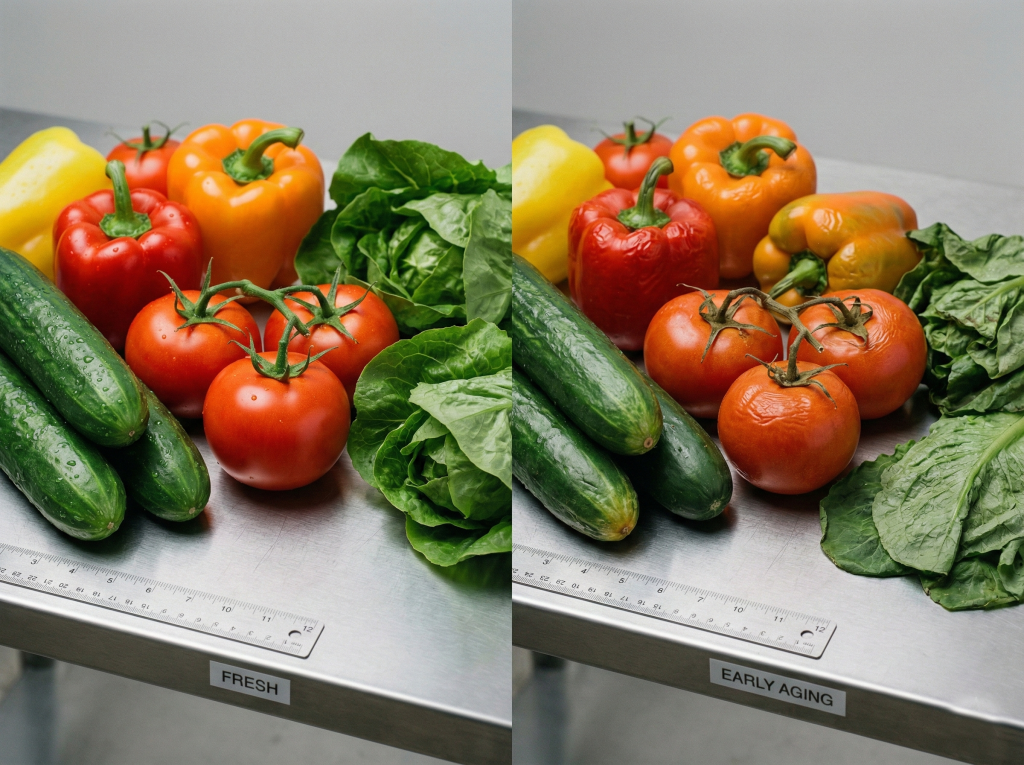
Early Signs Buyers Should Watch For
Understanding early warning signs helps prevent waste:
- Excess moisture inside cartons
- Slight sour or grassy odors
- Uneven coloring on the same batch
- Condensation on packaging
- Soft stems on leafy items
These do not always mean the produce is unusable—but they do mean shelf life is shorter than expected.
At this point, we’ve covered what freshness really depends on and why it is often misunderstood in the Dubai produce market. Next, we’ll look at vegetable freshness standards, seasonal effects (especially winter in the UAE), and how buyers can align sourcing decisions with real-world kitchen and storage conditions.
Vegetable Freshness Standards: What Actually Exists (and What Doesn’t)
Many buyers assume there is a single, enforced definition of freshness in the UAE. In reality, vegetable freshness standards are a mix of international guidelines, buyer expectations, and practical compromises.
There is no universal “freshness score.” Instead, quality is judged through a combination of:
- Grade (size, shape, cosmetic appearance)
- Condition (firmness, moisture, damage)
- Tolerance (how much variation is acceptable)
- Remaining shelf life under normal storage
Most exporters follow standards based on European or international norms. However, these standards focus more on marketability at arrival than performance after delivery.
This is where buyers often feel confused. A shipment can technically meet grade standards and still underperform in a busy kitchen or retail environment.
Why Freshness Standards Feel Inconsistent to Buyers
From the buyer’s side, inconsistency usually comes from three gaps:
1. Standards don’t account for usage timing
A hotel breakfast operation and a catering company may receive the same tomatoes. One uses them within 24 hours. The other holds them for three days.
The produce is identical. The outcome is not.
2. Storage conditions vary widely after delivery
Cold rooms differ. Staff handling differs. Even stacking methods differ.
Once produce leaves controlled wholesale storage, its condition depends heavily on the buyer’s systems.
3. Produce behaves differently by season
A cucumber in January is not the same as a cucumber in August, even if it looks similar on arrival.
This seasonal effect is one of the least discussed—but most impactful—factors in the produce supply chain UAE buyers rely on.
Seasonal Reality: Why Winter Produce Feels “Better” in the UAE
Winter is often described as the best time to buy fruits and vegetables in Dubai. This perception exists for good reasons.
Cooler transit temperatures reduce stress
During winter months:
- Ambient temperatures during loading and unloading are lower
- Cold chain breaks are less severe
- Produce respiration slows naturally
This leads to longer usable shelf life across many categories.
Peak harvest alignment improves quality
Many exporting regions supplying the UAE are in peak or shoulder harvest during winter. This means:
- Better maturity at harvest
- Higher yields
- Less pressure to rush product to market
As a result, buyers notice fewer defects and more consistent performance.
Winter Does Not Mean “Risk-Free”
While winter improves conditions, it does not eliminate risk.
Common winter-specific issues include:
- Overconfidence leading to over-ordering
- Mixed loads where one sensitive item affects others
- Longer storage because produce “seems fine”
Freshness loss is slower in winter—but it still happens.
Import vs Local: A Balanced View
The local-versus-imported debate is often framed emotionally. In practice, it is a logistical decision.
Strengths of local produce
- Shorter transport time
- Faster response to demand changes
- Good for herbs, leafy greens, and certain vegetables in season
Limitations of local supply
- Limited scale
- Quality variation outside peak months
- Sensitivity to heat and water conditions
Strengths of imported produce
- Greater consistency year-round
- Access to multiple growing regions
- Established grading and packing systems
Tradeoffs buyers should accept
Imported produce often trades absolute “just-picked” freshness for predictability. For many businesses, predictability reduces waste more than chasing the shortest harvest distance.
Why Prices Fluctuate Even When Quality Seems the Same
One of the most common buyer frustrations is price movement without visible quality change.
Several factors drive this:
- Air freight availability
- Fuel costs
- Weather events in source regions
- Demand spikes from hospitality or events
- Border or inspection delays
None of these are visible on the product itself, yet they directly affect landed cost.
This is why price and freshness do not always move together. Cheaper does not always mean older. More expensive does not always mean better.
Real-World Scenarios Buyers Recognize
Scenario 1: “It looked fine on delivery”
A catering company receives leafy greens that appear acceptable. Two days later, they collapse in storage.
Likely cause: a short cold chain break before delivery that reduced shelf life but did not show immediately.
Scenario 2: “Wholesale quality feels unpredictable”
A restaurant switches from retail to wholesale sourcing and experiences mixed results.
Likely cause: wholesale produce requires better rotation discipline and storage practices. Without these, waste increases.
Scenario 3: “Winter produce spoiled slower last year”
Seasonal differences between years matter. Weather patterns, not just months, affect quality.
Common Mistakes That Reduce Freshness After Purchase
Many freshness issues originate after the buyer takes ownership.
Common mistakes include:
- Storing different produce types together
- Washing produce too early
- Blocking airflow in cold rooms
- Ignoring first-in, first-out rotation
- Assuming staff “know” how to handle produce
Small process improvements often deliver bigger gains than changing suppliers.
Practical Ways Buyers Can Judge Freshness Better
Instead of relying only on appearance, experienced buyers look for:
- Weight: fresh produce feels heavier for its size
- Elasticity: gentle pressure reveals internal condition
- Stem condition: especially on leafy items
- Smell: early spoilage often announces itself quietly
These checks take seconds and prevent days of waste.
In the next section, we’ll connect these insights to practical sourcing decisions, including when wholesale makes sense, when retail may be safer, and how experienced buyers reduce risk without chasing unrealistic freshness ideals.
Choosing the Right Sourcing Model: Wholesale, Retail, or Mixed
There is no single “best” way to buy produce in Dubai. The right approach depends on volume, storage capacity, menu flexibility, and risk tolerance.
Experienced buyers often move away from rigid thinking and adopt a mixed sourcing strategy.
When wholesale sourcing works best
Wholesale sourcing is usually effective when:
- Volumes are predictable
- Storage conditions are well managed
- Staff understand produce handling basics
- Menus can adapt slightly to seasonal variation
Wholesale produce often arrives closer to its original packing condition. This can mean better underlying quality, but it also means the buyer carries more responsibility for rotation and storage.
In practice, suppliers working closely with Dubai-based distributors such as JMB Farm Fresh often observe that buyers who invest in basic handling discipline see more consistent results than those who chase cosmetic perfection.
When retail sourcing may reduce risk
Retail purchasing can make sense when:
- Volumes are small or irregular
- Storage space is limited
- Immediate visual quality matters more than shelf life
- Staff turnover makes training difficult
Retail channels absorb some handling risk for the buyer. The tradeoff is higher cost and less transparency around origin and handling history.
Understanding Tradeoffs Instead of Chasing “Perfect Freshness”
One of the most common mistakes buyers make is assuming that “fresher” always means “better.”
In reality, every sourcing decision involves tradeoffs:
- Speed vs stability
- Appearance vs performance
- Flexibility vs predictability
For example, a slightly more mature tomato may hold up better in a high-volume kitchen than a very fresh but fragile one. The goal is not maximum freshness in theory, but usable freshness in practice.
Freshness and Waste: The Hidden Cost Buyers Feel Most
Spoilage rarely appears as a single dramatic failure. It shows up quietly:
- Trim loss increases
- Prep time goes up
- Portions shrink
- Staff lose confidence in the product
Over time, these small losses add up.
Many buyers focus heavily on purchase price while underestimating how much waste costs them downstream. Improving freshness handling often reduces overall cost more effectively than negotiating price.
Simple Process Improvements That Make a Real Difference
You do not need complex systems to protect freshness. Small, consistent habits matter more.
Receiving practices
- Check temperature on arrival, not just appearance
- Reject excessive moisture inside cartons
- Separate sensitive items immediately
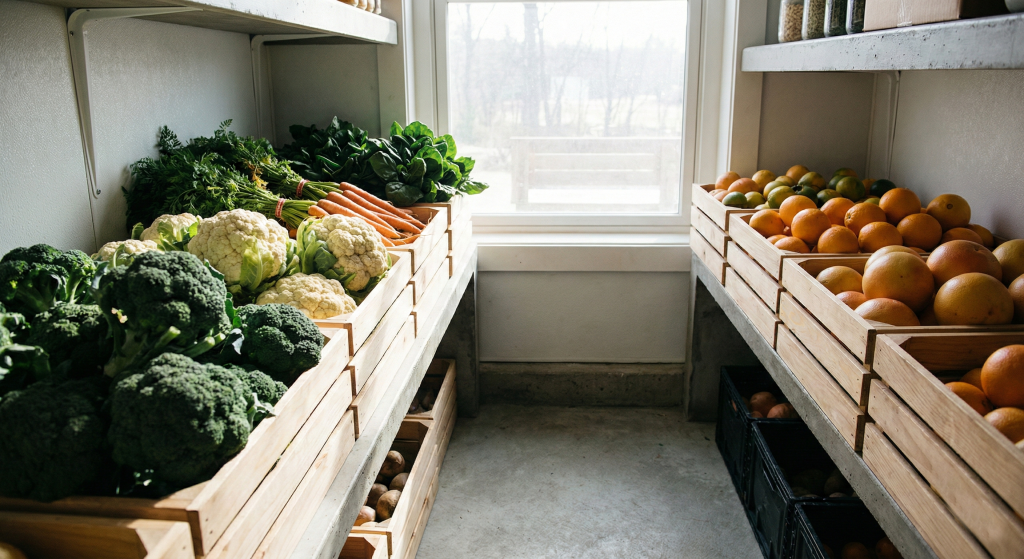
Storage discipline
- Avoid over-stacking crates
- Maintain airflow in cold rooms
- Store ethylene-sensitive produce away from ripening fruits
(Ethylene is a natural gas some fruits release that speeds ripening.)
Usage planning
- Use fragile items first, even if they look “better”
- Match menu planning to actual shelf life
- Avoid washing produce until close to use
These practices apply equally to households, restaurants, and catering operations.
Why Buyers Sometimes Feel “Misled” About Freshness
Most freshness disputes are not caused by dishonesty. They are caused by misaligned expectations.
Suppliers often think in terms of:
- Arrival condition
- Compliance with grade
- Transport limitations
Buyers think in terms of:
- How long it lasts
- How it performs in their kitchen
- How consistent it feels week to week
When these perspectives are not discussed openly, frustration builds.
Clear conversations about intended use, not just product name and price, reduce this gap significantly.
A More Practical Definition of “Fresh” in Dubai
In the UAE context, a more useful definition of fresh is:
Produce that arrives in good condition, has predictable shelf life under proper storage, and performs consistently for its intended use.
This definition accepts reality:
- Most produce is imported
- Climate adds risk
- Seasonality matters
- Handling matters as much as harvest
Freshness is not a moment in time. It is a managed process.
What Informed Buyers Do Differently
Buyers who experience fewer freshness issues tend to:
- Track which items fail fastest
- Adjust ordering frequency, not just quantity
- Accept seasonal variation instead of fighting it
- Invest in staff awareness
- Choose reliability over novelty
They also recognize that no supply chain is perfect—but many are predictable when understood.
Conclusion: Freshness Is a Shared Responsibility
“Fresh” in the Dubai produce supply chain is not a promise—it is an outcome.
It depends on farms, logistics, distributors, and buyers working within real-world limits. When expectations are grounded and systems are aligned, freshness improves naturally.
For businesses and families alike, understanding how produce behaves—rather than chasing labels—leads to less waste, better meals, and fewer surprises.
Frequently Asked Questions
1. Is wholesale produce less fresh than supermarket produce in Dubai?
Not necessarily. Wholesale produce often moves faster and is handled fewer times, but it requires better storage and rotation by the buyer.
2. Why does produce spoil faster in summer than winter?
Higher temperatures increase respiration and stress, making cold chain breaks more damaging during summer months.
3. Does imported produce last longer than local produce?
Sometimes. Imported produce is often selected and packed for shelf stability, while local produce may be fresher but more delicate.
4. What is the biggest cause of freshness loss after delivery?
Improper storage and handling after receipt, especially airflow issues and mixed storage of incompatible items.
5. How can small buyers reduce waste without changing suppliers?
Improve rotation, delay washing, store items correctly, and plan usage based on shelf life rather than appearance.








 Home
Home  Whishlist
  Compare
  Checkout