















Introduction

4
Walk through any premium supermarket or wholesale fruit market in Dubai, and you will see rows of familiar produce—apples, oranges, berries, bananas. But occasionally, tucked between exotic imports, there is a fruit that looks almost artificial in its geometry.
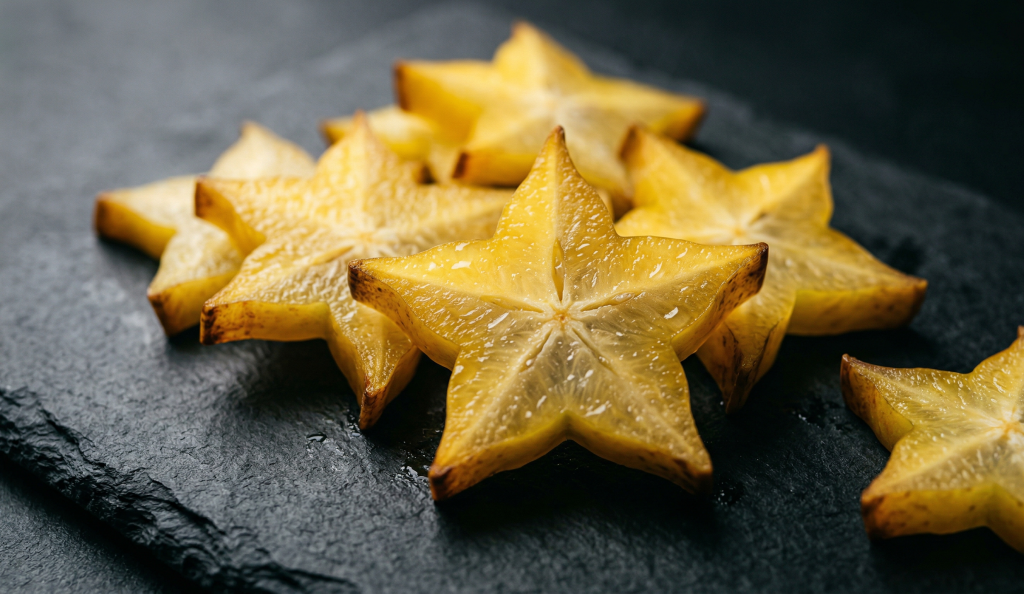
Slice it once, and it forms a perfect five-point star.
This is carambola, commonly known as star fruit.
Despite its visual appeal, stable supply chains, and growing demand in certain expat communities, it remains one of the least understood—and least purchased—fresh fruits in the UAE.
Most buyers recognize it. Very few understand it. Even fewer know how to source it properly.
This gap matters more than it seems. For restaurants, caterers, and even households, misunderstanding a fruit like this often leads to:
- Overpaying for low-quality imports
- Poor storage decisions that shorten shelf life
- Missed opportunities in presentation and menu differentiation
This article breaks down what star fruit actually is, how it behaves in Dubai’s supply chain, and why it is quietly one of the most underutilized fruits in the market today.
What Is Star Fruit (Carambola), Really?
Star fruit, or carambola, is a tropical fruit native to Southeast Asia. It grows on small trees and is typically harvested when firm but mature.
Its defining feature is its shape. The fruit has five distinct ridges, and when sliced horizontally, each piece forms a star.
But beyond appearance, what matters to buyers is its eating profile and handling characteristics.
Taste Profile (Often Misunderstood)
One of the biggest reasons people hesitate to buy star fruit is confusion about its taste.
In reality, it sits somewhere between:
- Mild citrus (like a diluted orange)
- Green apple (slightly tart)
- A hint of grape-like sweetness
The flavor depends heavily on ripeness:
- Green to light yellow → more sour, firmer texture
- Golden yellow with slight browning on edges → sweeter, juicier, more balanced
This variability is where many first-time buyers go wrong. They try it once—often under-ripe—and assume the fruit itself is not good.
Why Star Fruit Is Rarely Bought Fresh in Dubai
1. It Falls Into the “Exotic but Unclear” Category
Dubai’s produce market is heavily segmented:
- Everyday staples (high turnover, predictable demand)
- Seasonal premium fruits (berries, cherries, stone fruits)
- Exotic imports (lower turnover, higher uncertainty)
Star fruit sits in the third category.
Unlike mangoes or dragon fruit, it does not have strong cultural familiarity across all communities. Demand tends to come from:
- Filipino households
- Southeast Asian consumers
- Select high-end restaurants
For most other buyers, it remains a “visual fruit,” not a functional one.
2. Retail Display vs Real Freshness
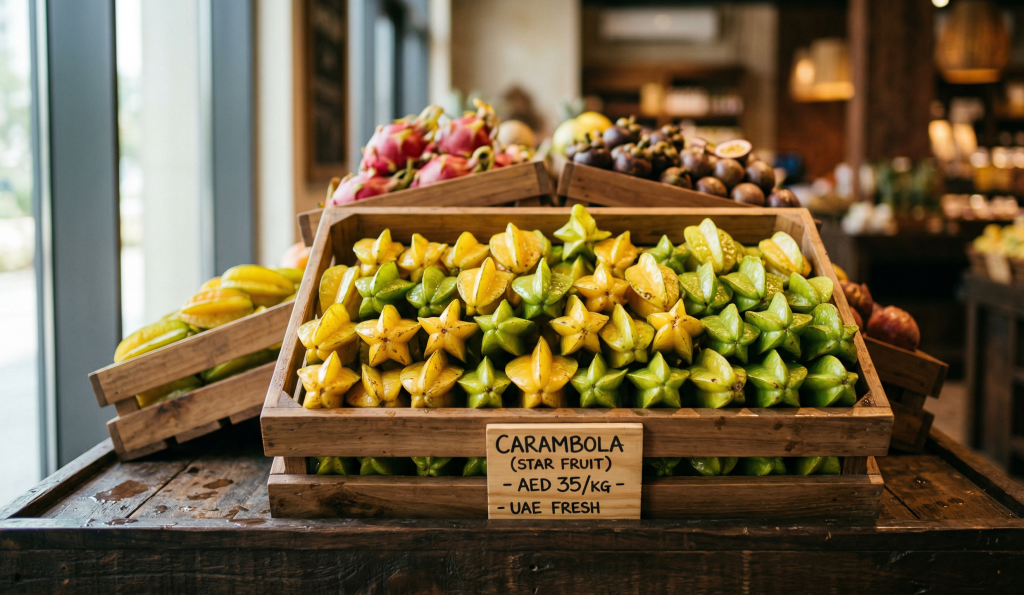
In many retail environments, star fruit is displayed for visual appeal rather than turnover.
This creates a common issue:
- Fruit sits longer on shelves
- Edges begin to brown
- Texture softens unevenly
To an untrained buyer, this looks like poor quality. In reality, it is often a stock rotation issue, not a sourcing issue.
Wholesale channels behave differently. Faster movement usually means:
- More consistent ripeness
- Better shelf life after purchase
- Lower chance of internal breakdown
3. Lack of Practical Knowledge
A recurring pattern across buyer discussions—whether in hospitality groups or online forums—is simple:
People do not know what to do with star fruit.
Common questions include:
- “How do you eat star fruit?”
- “Is it supposed to be sour?”
- “Do you peel it?”
Because these questions remain unanswered at the point of purchase, the fruit often gets skipped entirely.
How Star Fruit Moves Through Dubai’s Supply Chain
Understanding supply is key to buying it correctly.
Imported, Not Locally Grown
Star fruit is not commercially grown in the UAE at scale. Nearly all supply is imported, typically from:
- Malaysia
- Thailand
- India (limited volumes)
- Sri Lanka
This means availability is tied to:
- Export cycles
- Air freight schedules
- Import consolidation patterns
Seasonality in the UAE Context
Globally, star fruit can be harvested multiple times a year. But in Dubai, what matters is import consistency, not just harvest cycles.
In practice, buyers often see:
- More stable availability during winter and early spring
- Slight variability during peak summer due to logistics pressure
This is why star fruit occasionally appears “inconsistent” in quality—it is less about the fruit itself and more about how it travels.
Price Fluctuation Explained
Buyers often assume exotic fruits are always expensive. That is not entirely accurate.
Star fruit pricing fluctuates based on:
- Air freight costs
- Shipment size (consolidated vs partial loads)
- Demand spikes from specific communities
Because demand is relatively niche, prices can sometimes drop quietly when supply exceeds immediate buyers.
This creates short windows where it becomes a highly cost-effective fruit for presentation-heavy use.
How to Identify Fresh Star Fruit (Practical Buying Guide)
4
Whether you are sourcing for a restaurant or buying for home, selection matters more than most people realize.
Look at Color First
- Light green → not ready, more acidic
- Bright yellow → ideal balance
- Deep yellow with slight brown edges → fully ripe, sweeter
Brown edges are not necessarily a defect. They often indicate maturity.
Check Firmness
A good star fruit should feel:
- Firm but not hard
- Slightly yielding when pressed
Too soft means it is past peak.
Inspect the Ridges
The ridges (the edges that form the star shape) should be:
- Intact
- Slightly crisp
If they are heavily bruised or collapsing, shelf life will be limited.
Avoid Common Buyer Mistakes
- Choosing based only on color uniformity
- Avoiding slight browning (which can indicate ripeness)
- Buying in bulk without testing one piece first
In practice, experienced buyers often test a small quantity before scaling their order—especially when working with less familiar fruits.
How to Eat Star Fruit (Without Overthinking It)
One of the simplest aspects of star fruit is also the least communicated.
You do not need to peel it.
You do not need complex preparation.
Basic method:
- Wash thoroughly
- Slice horizontally
- Remove seeds if present
- Eat fresh
That is it.
The entire fruit is edible, including the skin.
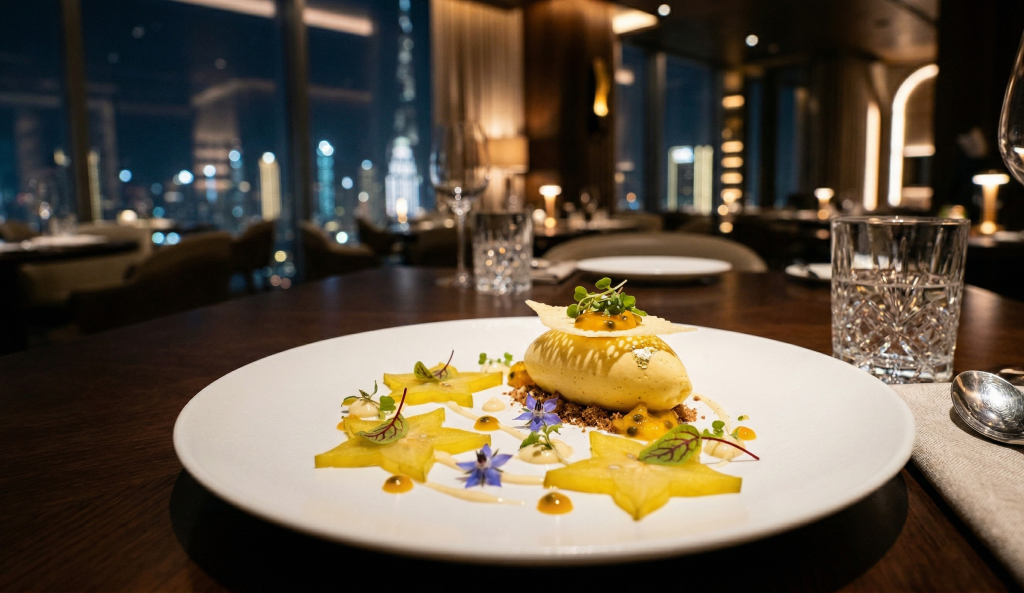
For hospitality settings, it is often used for:
- Beverage garnishes
- Dessert plating
- Salad accents
Not because it is rare—but because it is visually consistent.
Where Star Fruit Actually Makes Sense in Dubai
The value of star fruit is not in volume consumption. It is in targeted use.
Restaurants and Cafés
Used correctly, it offers:
- High visual impact
- Low preparation effort
- Consistent plating results
This is why it quietly appears in:
- Brunch spreads
- Juice bars
- Tropical-themed menus
Catering Businesses
For events, especially in Dubai’s hospitality environment, presentation matters.
Star fruit provides:
- Uniform slices
- Recognizable but still “different” appearance
- Minimal waste when handled properly
Households (Especially Expat Communities)
In Filipino and Southeast Asian households, star fruit is more familiar.
It is used in:
- Fresh snacks
- Light salads
- Juice blends
However, outside these communities, adoption remains limited due to lack of exposure.
A Note on Wholesale vs Retail Sourcing
This is where many buyers quietly struggle.
Retail sourcing often leads to:
- Inconsistent freshness
- Higher per-unit cost
- Limited visibility into supply cycles
Wholesale sourcing, when done properly, offers:
- Better rotation (fresher stock)
- More predictable quality
- Access to different grades
That said, wholesale is not always ideal for everyone.
Tradeoffs include:
- Minimum order quantities
- Need for storage planning
- Risk of overbuying if demand is uncertain
In practice, suppliers working closely with Dubai-based distributors such as JMB Farm Fresh often observe that buyers who understand their actual usage patterns tend to benefit the most from wholesale—not those simply trying to reduce cost.
Why This Fruit Is Still Overlooked
At its core, the issue is not supply.
It is not quality.
It is not even price.
It is clarity.
When buyers do not understand:
- How a fruit tastes
- When it is at peak
- How to use it
They default to what they already know.
In Dubai’s fast-moving food environment, familiarity often wins over curiosity.
That is why star fruit continues to sit in the background—visually striking, consistently available, but rarely chosen with intention.
The Real Cost of Getting Star Fruit Wrong
For most buyers, star fruit looks simple. But in practice, it behaves like many other imported tropical fruits—small mistakes at the buying stage lead to waste later.
This is especially relevant in Dubai, where storage conditions, delivery timing, and usage planning all influence how long produce actually lasts.
1. Overbuying Without a Clear Use Case
One of the most common mistakes in both households and small cafés is buying star fruit “because it looks good.”
The issue is not the fruit—it is the lack of a defined use.
Star fruit has:
- Moderate shelf life (typically a few days at peak ripeness)
- Limited versatility compared to staples like apples or bananas
- A flavor profile that does not dominate dishes
Without a plan, it often ends up unused.
In commercial settings, this translates to:
- Increased waste
- Lower yield per purchase
- Unnecessary cost per plate
2. Misjudging Ripeness at Purchase
Because star fruit continues to soften after arrival, timing matters.
Buyers who purchase fully ripe fruit without immediate use often face:
- Rapid softening within 24–48 hours
- Loss of structural integrity (important for presentation)
- Decline in visual appeal
On the other hand, buying overly green fruit without allowing time to ripen leads to:
- Sour taste
- Poor customer experience (especially in hospitality settings)
This balance is rarely explained at the point of sale.
3. Storage Errors in UAE Conditions
Dubai’s climate adds another layer of complexity.
Even though most produce is stored in controlled environments, the transition from supplier → transport → kitchen or home can affect quality.
Common storage mistakes include:
- Refrigerating overly early (which can dull flavor)
- Leaving ripe fruit at room temperature too long
- Stacking fruit in a way that damages the ridges
Best practice is simple:
- Store slightly underripe fruit at room temperature until it turns yellow
- Move to refrigeration once it reaches ideal ripeness
- Avoid pressure or stacking
These small adjustments can extend usable life significantly.
Star Fruit in Professional Kitchens: Where It Actually Performs

4
In restaurant environments, star fruit is not used as a volume ingredient.
It is used as a precision ingredient.
Visual Consistency Without Skill Dependency
Many garnishes require technique.
Star fruit does not.
Every slice naturally forms a star, which means:
- Minimal training required for staff
- Consistent presentation across shifts
- Reduced dependency on skilled garnish prep
This is particularly useful in high-turnover kitchens.
Menu Positioning Without Cost Pressure
Compared to premium berries or imported stone fruits, star fruit often sits in a mid-range pricing category.
This allows chefs to:
- Add visual value without significantly increasing cost per dish
- Maintain margin while improving presentation
It is not about replacing core ingredients—it is about enhancing them.
Limitations Chefs Quietly Acknowledge
Despite its advantages, experienced chefs understand where star fruit does not perform well:
- It lacks strong flavor impact
- It does not hold well under heat
- It can become too soft if pre-cut and stored
This is why it is rarely used in:
- Cooked dishes
- Heavy sauces
- High-acidity recipes
Instead, it stays in the realm of fresh, cold, or lightly handled applications.
The Role of Expat Demand in Keeping It Relevant
Dubai’s food market is shaped heavily by its population mix.
Star fruit demand is not evenly distributed—it is concentrated.
Filipino and Southeast Asian Communities
For many Filipino households, star fruit is not exotic.
It is familiar.
It is used in:
- Fresh consumption
- Light pickling
- Juice blends
This creates a steady, baseline demand that keeps import volumes viable.
Why Broader Adoption Has Not Happened
Despite availability, star fruit has not crossed into mainstream consumption for a few reasons:
- Limited awareness of how to eat it
- Lack of strong flavor identity
- Competition from more familiar fruits
In a market like Dubai, where convenience drives buying behavior, unfamiliar fruits must offer either:
- Strong taste
- Clear utility
- Cultural familiarity
Star fruit offers visual appeal—but that alone is not enough for mass adoption.
Comparing Star Fruit to Other Exotic Fruits in Dubai
To understand its position better, it helps to compare it with similar “exotic” categories.
vs Dragon Fruit
- Dragon fruit has gained traction due to health perception and Instagram visibility
- Star fruit remains more functional than trendy
vs Mango (Imported Premium Varieties)
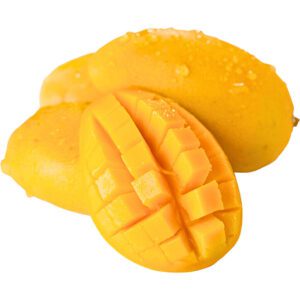
- Mango has strong emotional and cultural demand
- Star fruit does not compete on taste or familiarity
vs Berries
- Berries offer strong flavor and repeat consumption
- Star fruit is more occasional, not habitual
Where Star Fruit Wins
It wins in a narrow but clear space:
- Visual presentation
- Ease of preparation
- Predictable slicing result
This makes it a supporting ingredient, not a centerpiece.
When Is the Best Time to Buy Star Fruit in Dubai?
Timing matters more than most buyers realize.
Winter to Early Spring: More Stable Supply
During cooler months, supply chains tend to stabilize:
- Better air freight conditions
- More consistent arrivals from Southeast Asia
- Lower spoilage risk during transport
This is when buyers are more likely to find:
- Better quality
- More consistent pricing
- Reliable availability
Summer: Logistics Pressure Increases
In peak summer:
- Heat adds stress during handling
- Freight priorities shift
- Shelf life can be slightly reduced
This does not mean star fruit disappears—but quality consistency can vary more.
Practical Buying Insight
Instead of focusing only on “season,” experienced buyers watch for:
- Consistent batch quality
- Stable pricing over multiple weeks
- Reliable supplier rotation
These signals matter more than calendar timing.
Should You Buy Star Fruit From Retail or Wholesale?
This depends entirely on usage.
Retail Works When:
- You are testing the fruit for the first time
- You need very small quantities
- Usage is occasional
Wholesale Works When:
- You understand your usage pattern
- You need consistency
- You want better control over ripeness stages
However, wholesale requires discipline:
- Planning usage in advance
- Managing storage correctly
- Avoiding impulse overordering
Buyers who treat wholesale like retail often run into problems.
The Quiet Opportunity Most Buyers Miss
There is a pattern that repeats across Dubai’s produce market.
Fruits that are:
- Easy to handle
- Visually strong
- Moderately priced
…often become valuable once buyers understand them.
Star fruit fits this profile exactly.
But because it lacks strong marketing, cultural dominance, or aggressive retail push, it stays underutilized.
For buyers willing to learn its behavior, it becomes:
- A reliable garnish
- A low-risk presentation upgrade
- A consistent, easy-to-use fruit
Not essential.
But quietly useful.
Practical Buying Scenarios: How Different Buyers Should Approach Star Fruit
By this point, it should be clear that star fruit is not a high-volume staple. Its value depends entirely on how it is used.
Below are practical, real-world approaches based on buyer type.
For Restaurant Owners and Chefs
If you are running a kitchen, star fruit should not be treated as a primary ingredient.
It works best when:
- Used in small, controlled quantities
- Ordered alongside other produce (not as a standalone item)
- Integrated into dishes where visual consistency matters
A common approach in professional kitchens is:
- Order a small batch first
- Test across 2–3 menu items (garnish, dessert, beverage)
- Evaluate waste vs usage over a week
This removes guesswork and avoids overcommitment.
For Catering Companies
Catering operates differently from restaurants.
Presentation is often more important than flavor complexity.
Star fruit fits well in:
- Fruit platters
- Buffet displays
- Beverage stations
Its advantages here are simple:
- Predictable shape
- Easy portioning
- Minimal prep time
However, timing is critical. Cutting too early reduces quality. Cutting too late creates pressure during service.
For Grocery Buyers and Resellers
For small grocery operations or specialty stores, star fruit presents a different challenge.
It is not a fast-moving item.
Success depends on:
- Proper display rotation
- Educating customers (even briefly)
- Avoiding overstocking
Stores that treat it as a decorative item often see slower sales.
Stores that explain it—even with a simple “slice to see the star shape” note—tend to see better turnover.
For Households
For home buyers, the simplest approach is also the most effective:
- Buy one or two pieces
- Let them ripen fully
- Try them fresh
If the taste fits your preference, then increase quantity next time.
This removes the risk of waste and builds familiarity gradually.
Common Misunderstandings That Keep Buyers Away
Even among experienced buyers, a few misconceptions continue to limit adoption.
“It’s Just for Decoration”
This is partly true—but incomplete.
While star fruit is widely used for presentation, it is still:
- Fully edible
- Hydrating
- Mildly refreshing
It is not just visual—it is simply not a dominant flavor fruit.
“It’s Always Expensive”
Because it is categorized as “exotic,” many assume it carries a constant premium.
In reality:
- Prices fluctuate
- Supply occasionally exceeds demand
- It can become relatively affordable during stable import periods
The perception of high cost often persists even when market conditions change.
“It Doesn’t Taste Like Much”
This depends entirely on ripeness.
Underripe star fruit is noticeably sour.
Properly ripened fruit offers a balanced, light sweetness.
The issue is not the fruit—it is timing.
“It Spoils Too Fast”
Compared to berries, star fruit actually has a reasonable shelf life when handled correctly.
Most spoilage issues come from:
- Buying at the wrong ripeness stage
- Poor storage practices
- Delayed usage after peak ripeness
With basic handling awareness, this becomes manageable.
A Balanced View: Where Star Fruit Fits — And Where It Doesn’t
It is important to stay realistic.
Star fruit is not a breakthrough ingredient.
It will not replace core fruits in your supply chain.
But it does have a clear role.
Where It Works Well
- Garnishes and plating
- Cold applications
- Visual enhancement
- Low-skill prep environments
Where It Falls Short
- Strong flavor-based recipes
- Cooking or heat-heavy dishes
- Bulk consumption
- Long storage without planning
Understanding both sides is what allows buyers to use it effectively—without unrealistic expectations.
Final Thoughts: Why Understanding Matters More Than Availability
Dubai does not lack access to fresh produce.
In fact, it has one of the most diverse imported fruit markets in the region.
The real gap is not supply.
It is understanding.
Star fruit is a clear example of this.
It is:
- Consistently available
- Logistically supported through imports
- Visually distinctive
- Easy to handle
And yet, it remains underused.
Not because it is difficult.
But because it is unfamiliar.
In practice, suppliers and buyers who spend time understanding lesser-known fruits tend to make better decisions across their entire sourcing process—not just with one product.
That includes:
- Knowing when to buy
- Knowing how much to buy
- Knowing how to store and use what they purchase
These are small shifts.
But in a market where waste, inconsistency, and cost control matter daily, they add up.
FAQ: Star Fruit in Dubai (Carambola)
1. What is star fruit and how does it taste?
Star fruit, or carambola, is a tropical fruit that forms a star shape when sliced. It has a mild, slightly sweet and tangy taste, similar to a mix of citrus and green apple, depending on ripeness.
2. When is star fruit available in Dubai?
Star fruit is available year-round in Dubai through imports, but quality and consistency are usually better during winter and early spring due to more stable supply conditions.
3. How do you eat star fruit properly?
You can eat star fruit whole after washing. Simply slice it horizontally, remove seeds if present, and consume it fresh. The skin is edible and does not need to be peeled.
4. Why is star fruit not popular in Dubai?
It is less popular due to limited awareness, unclear taste expectations, and lack of familiarity compared to more commonly consumed fruits like mangoes or berries.
5. Can you store star fruit in the fridge?
Yes. Let it ripen at room temperature first, then refrigerate once it turns yellow. Proper storage helps maintain freshness and extends shelf life.








 Home
Home  Whishlist
  Compare
  Checkout