











Introduction
Walk into a high-end kitchen in Dubai during peak winter season, and you may notice something unusual on the prep table.
It looks like a beetroot.
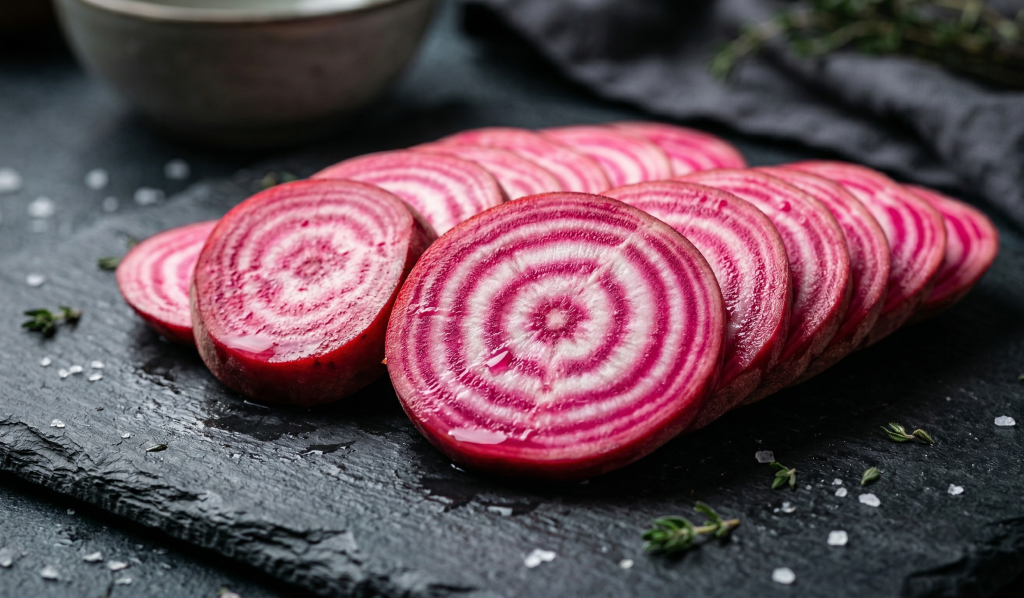
But when sliced, it reveals clean rings of pink and white—almost like a piece of candy.
This is Chioggia beetroot, often called candy beetroot. It has been quietly used by chefs across Dubai for years, yet it rarely appears in everyday retail baskets.
Not because it is rare.
Not because it is expensive.
But because most buyers simply don’t know what they are looking at—or how to use it.
This article breaks that gap.
We will look at what striped beetroot actually is, how it behaves in real kitchens, why it stays out of mainstream supply chains, and what buyers in Dubai should understand before sourcing it fresh.
What Is Candy Beetroot (Chioggia Beetroot)?
Candy beetroot, or Chioggia beetroot, is an heirloom variety originally from Italy.
On the outside, it looks similar to standard red beetroot—round, firm, and earthy.
But once cut, the difference is immediate:
- Alternating rings of white and pink
- A cleaner, less intense pigment than red beetroot
- A milder, slightly sweeter flavor profile
This visual structure is not just aesthetic. It affects how the beet behaves during cooking, plating, and storage.
Why It Stands Out in Professional Kitchens
Chefs use striped beetroot for one main reason: control.
Unlike red beetroot, which bleeds heavily and stains everything it touches, Chioggia beetroot:
- Holds its shape better in thin slicing
- Does not overpower other ingredients with color
- Works well in raw preparations like carpaccio or salads
This makes it especially useful in:
- Fine dining plating
- Cold starters
- Buffet presentations where visual clarity matters
However, this same advantage is also why it stays niche.
Most buyers are trained to associate beetroot with deep red color and strong flavor. Candy beetroot breaks that expectation.
Why Most Buyers in Dubai Overlook It
In produce supply, what gets bought is not always what is available.
Candy beetroot is a clear example of this disconnect.
1. Familiarity Bias
Most procurement decisions—whether in households or restaurants—follow routine.
Buyers stick to:
- Red beetroot
- Baby beetroot packs
- Pre-cooked vacuum beet options
Even when Chioggia beetroot is available in wholesale markets or specialty imports, it is often ignored because:
- It looks unfamiliar
- It is not listed clearly in standard ordering systems
- Staff are unsure how to use it
2. Misunderstanding of Value
There is a common assumption that “exotic vegetables” are:
- Expensive
- Difficult to handle
- Not worth the risk
In reality, candy beetroot often sits in a similar price band to premium baby beetroot—especially during winter import cycles.
The difference is not cost.
It is confidence.
3. Retail vs Wholesale Gap
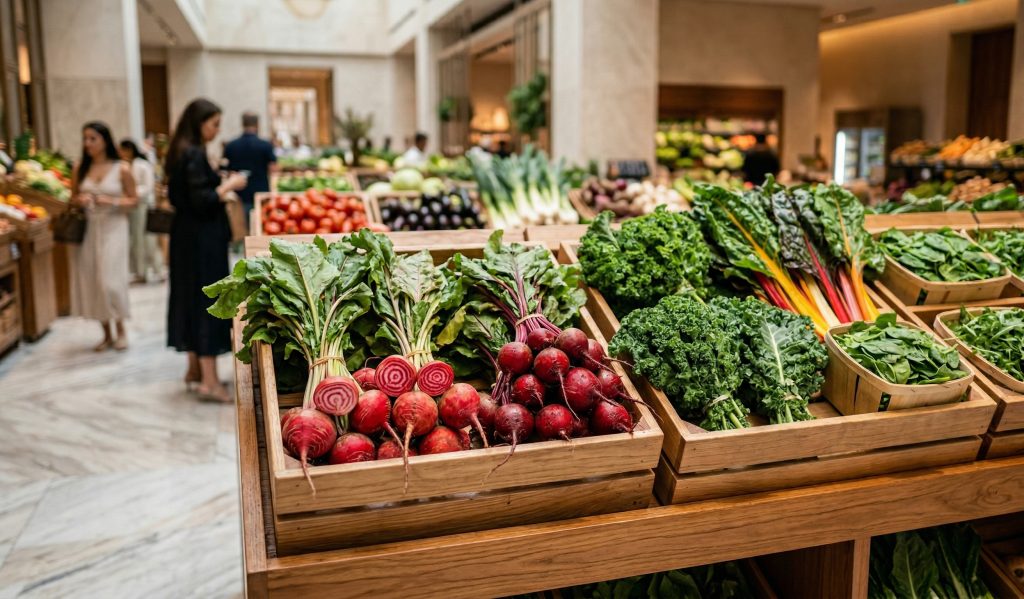
Retail supermarkets in Dubai rarely stock striped beetroot consistently.
Why?
Because:
- Shelf turnover is slower for unfamiliar items
- Packaging does not explain the difference clearly
- Casual buyers do not actively search for it
Meanwhile, wholesale channels—where chefs and procurement managers operate—do see occasional availability.
This creates a situation where:
- Professionals use it quietly
- General consumers remain unaware
Seasonal Context: When Does Candy Beetroot Actually Arrive in Dubai?
Understanding seasonality is critical in UAE produce sourcing.
Dubai’s fresh produce supply depends heavily on imports, especially for specialty vegetables.
Peak Window for Chioggia Beetroot
Candy beetroot typically appears during:
- Winter months (November to March)
- Aligning with European growing cycles (Italy, France, Netherlands)
During this time:
- Quality is more consistent
- Size uniformity improves
- Prices stabilize compared to off-season imports
What Happens Outside the Season?
Outside winter:
- Availability becomes irregular
- Imports may come from secondary sources with inconsistent quality
- Shelf life can drop due to longer transit times
For buyers, this matters.
Ordering striped beetroot outside its natural season often leads to:
- Softer texture
- Reduced visual contrast
- Higher spoilage risk
Fresh vs Pre-Cooked Beetroot: Why It Matters More Than You Think
One of the most common sourcing mistakes in Dubai is relying too heavily on pre-cooked beetroot.
It is convenient.
It is consistent.
But it changes the product entirely.
How Candy Beetroot Behaves Differently
When Chioggia beetroot is cooked:
- The pink rings fade significantly
- The visual appeal reduces
- The texture softens more quickly than red beetroot
This is why chefs prefer to:
- Slice it raw
- Lightly roast it at controlled temperatures
- Use it in dishes where structure matters
Pre-cooked versions lose the very feature that makes this beetroot valuable.
How to Identify High-Quality Striped Beetroot
Whether you are sourcing for a restaurant or a household, quality assessment is often misunderstood.
Here are practical indicators used in wholesale environments:
External Indicators
- Firm to touch (no softness or spongy feel)
- Smooth skin with minimal scarring
- Medium size (too large often means fibrous texture)
Internal Indicators (after cutting)
- Clear, defined rings (not blurred)
- No internal browning
- Moist but not watery texture
Storage Behavior
Candy beetroot is slightly more sensitive than standard beetroot.
If stored improperly:
- It loses firmness faster
- Sugar levels drop, affecting taste
- Rings become less visually distinct
Cold chain consistency plays a major role here—something often overlooked in fragmented sourcing setups.
In practice, suppliers working closely with Dubai-based distributors such as JMB Farm Fresh often observe that maintaining stable storage conditions is more critical for specialty vegetables than for staple items.
Common Mistakes Buyers Make (And Pay For Later)
Across restaurant procurement and household buying, the same patterns repeat.
Mistake 1: Treating It Like Regular Beetroot
Candy beetroot is not a substitute—it is a different product.
Using it in:
- Long stews
- Heavy boiling
- Juice blends
removes its key advantages.
Mistake 2: Buying Without a Use Case
Many buyers purchase exotic vegetables without a clear plan.
Result:
- It sits unused
- Shelf life expires
- Waste increases
Mistake 3: Ignoring Seasonality
Buying outside peak season leads to:
- Lower quality
- Higher cost
- Poor customer experience (especially in restaurants)
Where Does It Fit in Dubai’s Broader Produce Landscape?
Dubai’s produce market is structured around three main layers:
- Mass retail (supermarkets)
- Mid-tier supply chains (online grocery + distributors)
- Wholesale and hospitality procurement
Candy beetroot primarily exists in the third layer.
This matters because:
- Availability depends on importer relationships
- Visibility depends on buyer awareness
- Consistency depends on volume demand
As demand increases, supply stabilizes.
But until then, it remains a “quiet ingredient”—used by those who know, ignored by those who don’t.
How Chefs in Dubai Actually Use Candy Beetroot (And Why It Works)
In professional kitchens, ingredients are not chosen for novelty.
They are chosen for control, consistency, and how they behave under pressure.
Candy beetroot fits into a very specific category: high-precision vegetables.
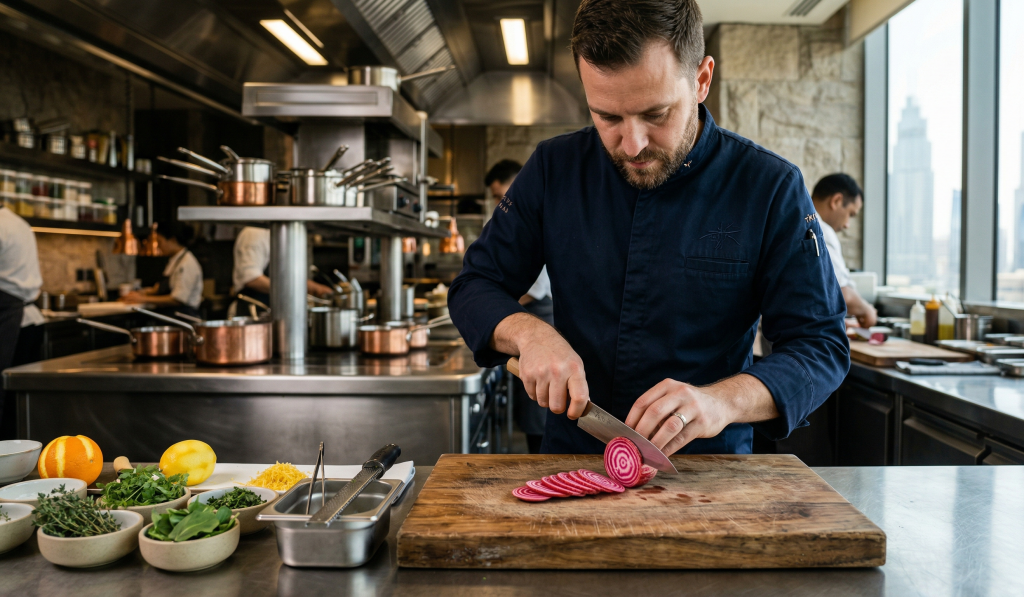
1. Raw Preparations Where Visual Integrity Matters
One of the most common uses is in thinly sliced preparations.
- Beetroot carpaccio
- Cold salads with citrus or soft cheese
- Layered starters in tasting menus
Because Chioggia beetroot does not bleed like red beetroot, it allows chefs to:
- Keep plates clean
- Maintain color separation
- Avoid staining other ingredients like goat cheese or yogurt
This is especially important in fine dining and hotel buffets, where presentation must hold for hours.
2. Light Roasting for Texture Control
When roasted gently (not aggressively), candy beetroot:
- Retains a slight firmness
- Develops mild sweetness without becoming earthy
- Keeps some of its internal pattern
However, temperature control is critical.
Over-roasting leads to:
- Loss of structure
- Fading of the signature rings
- A result that looks similar to standard beetroot
This is why experienced kitchens often roast it separately, not mixed with other root vegetables.
3. Pickling (With Caution)
Some chefs pickle Chioggia beetroot, but with a lighter brine.
The goal is to:
- Preserve texture
- Add acidity without overpowering sweetness
- Maintain visual clarity
Heavy pickling solutions tend to dull the color contrast, which defeats the purpose.
Why It Rarely Appears on Menus (Even When It’s Used)
This is one of the more interesting dynamics in Dubai’s food scene.
Candy beetroot is often present in dishes—but not named.
Reason 1: Menu Simplicity
Most menus avoid listing specific varieties unless necessary.
Instead of writing:
- “Chioggia beetroot salad”
You will often see:
- “Beetroot salad”
From a customer perspective, the detail does not change the decision.
From a kitchen perspective, it makes a significant difference.
Reason 2: Supply Inconsistency
Restaurants avoid highlighting ingredients that:
- May not be available every week
- Depend on import cycles
- Have fluctuating quality
Since Chioggia beetroot is seasonal and not always guaranteed, chefs use it quietly when available.
Reason 3: Low Consumer Awareness
Unlike items such as avocado or asparagus, candy beetroot:
- Does not have strong consumer demand
- Is not widely recognized by name
- Does not drive orders on its own
So it remains a behind-the-scenes upgrade rather than a headline ingredient.
The Supply Chain Reality: Why “Exotic Vegetables” Feel Inconsistent
Many buyers in Dubai—especially new restaurant owners—struggle with one core issue:
Why does availability keep changing?
Candy beetroot is a good case study to understand this.
1. Import Dependency
Unlike staple vegetables, Chioggia beetroot is:
- Not widely grown locally in the UAE
- Dependent on European farms during winter
This means supply is tied to:
- Harvest cycles
- Export logistics
- Shipping timelines
A delay at any point affects availability in Dubai.
2. Volume Threshold Problem
Importers prioritize products with predictable demand.
Since candy beetroot:
- Moves in smaller volumes
- Is not part of daily ordering lists
it often gets deprioritized in shipments.
This creates a cycle:
- Low demand → inconsistent supply
- Inconsistent supply → low demand
3. Cold Chain Sensitivity
Specialty vegetables require tighter temperature control.
Breaks in the cold chain can lead to:
- Texture loss
- Internal discoloration
- Faster spoilage
In fragmented sourcing setups—where buyers rely on multiple small vendors—this becomes a real risk.
Some UAE buyers prefer working with more structured supply partners to reduce this variability, rather than relying on scattered retail sourcing.
Wholesale vs Retail: Where Should You Actually Buy It?
This is one of the most misunderstood parts of produce sourcing in Dubai.
Retail Supermarkets
Pros:
- Convenient
- Clean packaging
- Easy access
Limitations:
- Limited variety
- Inconsistent stocking of specialty items
- Higher markup for niche produce
Candy beetroot, if available at all, usually appears:
- In small quantities
- Without clear labeling
- At irregular intervals
Wholesale Channels
Pros:
- Better access to variety
- Larger volumes
- More direct connection to import cycles
Limitations:
- Requires planning
- Minimum order quantities in some cases
- Less curated presentation
For items like striped beetroot, wholesale channels are usually where availability starts.
Online Grocery & Mid-Tier Distributors
This is the fastest-growing segment in Dubai.
They sit between retail and wholesale, offering:
- Better variety than supermarkets
- More flexibility than wholesale markets
However, quality still depends on:
- Supplier relationships
- Storage handling
- Turnover speed
Pricing Volatility: What Buyers Often Misinterpret
One of the most frequent concerns in UAE produce sourcing is price fluctuation.
Candy beetroot highlights why this happens.
It’s Not Just About “Expensive vs Cheap”
Prices move based on:
- Seasonality (peak vs off-season)
- Freight costs (air vs sea)
- Batch quality (uniform vs mixed sizes)
- Demand from hospitality sector
During peak winter:
- Prices stabilize
- Quality improves
- Supply is more predictable
Outside peak season:
- Prices can increase
- Quality becomes inconsistent
- Buyers take on more risk
The Real Cost Is Not the Purchase Price
For restaurants and catering businesses, the bigger issue is:
- Waste from unusable stock
- Inconsistent plating results
- Customer dissatisfaction
Paying slightly more for consistent quality often reduces overall cost.
Local vs Imported: Is There a UAE-Grown Alternative?
This question comes up often, especially with growing interest in local agriculture.
Current Reality
Chioggia beetroot is still largely imported.
Local UAE farms:
- Focus on faster-growing, high-demand crops
- Prioritize yield efficiency over niche varieties
While experimental farming exists, it is not yet at scale for consistent supply.
What This Means for Buyers
- Imported produce remains the primary source
- Quality depends heavily on origin and transit
- Supplier selection becomes more important than price alone
Practical Buying Framework: When Should You Actually Choose Candy Beetroot?
For both businesses and households, the decision should be intentional.
Choose It When:
- Presentation matters (events, plated service)
- You need visual differentiation
- You are working with raw or lightly cooked dishes
Avoid It When:
- The dish involves heavy cooking
- Color retention is not important
- Cost efficiency is the main priority
This is not a daily-use vegetable.
It is a purpose-driven ingredient.
How to Store and Handle Candy Beetroot Properly
In Dubai’s climate, storage is not a minor detail.
It directly affects shelf life, taste, and visual quality.
Candy beetroot is slightly more delicate than standard red beetroot, so handling needs to be more intentional.
Short-Term Storage (1–5 Days)
- Keep in refrigeration (ideally 2–5°C)
- Store unwashed to prevent moisture buildup
- Place in a breathable bag, not sealed plastic
This helps maintain:
- Firmness
- Natural sugars
- Clean internal rings
Medium-Term Storage (5–10 Days)
If you need to hold it longer:
- Remove any attached greens (they draw moisture from the root)
- Wrap loosely in paper or perforated packaging
- Avoid stacking heavy items on top
Pressure damage can cause internal bruising, which is not visible until cutting.
What to Avoid
- Washing before storage
- Leaving at room temperature for extended periods
- Storing near high-moisture produce (like leafy greens)
These accelerate spoilage and reduce usability.
A Real-World Scenario: Where Buyers Get It Right (and Wrong)
To understand how candy beetroot fits into actual supply decisions, consider two typical situations in Dubai.
Scenario A: Restaurant Procurement
A mid-sized restaurant decides to add a beetroot starter to its menu.
They choose candy beetroot for visual impact—but:
- Order it without confirming seasonal availability
- Treat it like standard beetroot in preparation
- Overcook it
Result:
- The dish loses its visual identity
- Staff become frustrated with inconsistency
- The ingredient is removed from the menu
The issue was not the product.
It was the lack of alignment between sourcing and usage.
Scenario B: Planned Seasonal Use
Another kitchen approaches it differently.
They:
- Introduce candy beetroot only during winter
- Use it in raw or lightly roasted dishes
- Train staff on handling and slicing
Result:
- Consistent plating
- Minimal waste
- Better control over cost and quality
The difference comes down to planning, not availability.
The Bigger Insight: What Candy Beetroot Teaches About Produce Sourcing
At first glance, this is just a striped vegetable.
But in practice, it highlights several broader truths about the UAE produce market.
1. Availability Does Not Equal Awareness
Many high-quality ingredients exist within the supply chain but are underused because:
- Buyers are unfamiliar with them
- They are not promoted in retail environments
- There is limited education around usage
2. Seasonality Still Matters—Even in a Global City
Dubai has access to global produce year-round.
But:
- Quality still follows natural growing cycles
- Peak season still determines consistency
- Off-season sourcing always carries trade-offs
Ignoring this leads to:
- Higher costs
- Lower quality
- Increased waste
3. Consistency Is More Valuable Than Variety
For most buyers, especially in hospitality:
- A stable, predictable ingredient is more valuable than a unique one
Candy beetroot works best when:
- It is used intentionally
- Supply is understood
- Expectations are managed
A Quiet Note on Sourcing Practices in Dubai
In practice, experienced buyers often move away from fragmented sourcing over time.
Instead of:
- Purchasing small quantities from multiple vendors
- Reacting to daily availability
They shift toward:
- More structured supplier relationships
- Planned ordering cycles
- Better alignment with seasonal windows
Suppliers working closely with Dubai-based distributors—such as JMB Farm Fresh—often observe that this shift reduces:
- Waste
- Quality inconsistency
- Operational stress in kitchens
This is not about scale.
It is about predictability.
Final Thoughts
Candy beetroot is not a mainstream ingredient.
It does not need to be.
Its value lies in how it is used, not how widely it is known.
For those who understand it:
- It offers visual precision
- A cleaner flavor profile
- Greater control in plating
For those who don’t:
- It becomes another underused product in the supply chain
The difference is knowledge.
And in a market like Dubai—where access is rarely the problem—knowledge is often what separates efficient sourcing from expensive mistakes.
FAQ Section
1. What is candy beetroot and how is it different from regular beetroot?
Candy beetroot, also known as Chioggia beetroot, has pink and white rings inside and a milder flavor. It does not bleed as much as red beetroot, making it better for presentation-focused dishes.
2. Where can I buy candy beetroot in Dubai?
It is usually found in wholesale markets, specialty distributors, and occasionally online grocery platforms. Availability is higher during winter months.
3. Is candy beetroot available year-round in the UAE?
No. It is mainly available during winter (November to March) when imports from Europe are at their peak.
4. Can you cook candy beetroot like regular beetroot?
Yes, but heavy cooking reduces its visual appeal. It is best used raw, lightly roasted, or thinly sliced.
5. Why is candy beetroot not common in supermarkets?
Because demand is lower, shelf turnover is slower, and most buyers are unfamiliar with it compared to standard beetroot.








 Home
Home  Whishlist
  Compare
  Checkout