











Introduction: The Ingredient Everyone Recognizes, But Few Understand
Walk into any Mediterranean restaurant in Dubai, and you will likely find artichoke on the menu.
It shows up in salads, pastas, grilled platters, and even as a side dish with olive oil and lemon. Most people enjoy it without thinking much about it. But when it comes to cooking artichoke at home, the story changes.
For many buyers—whether home cooks or even small F&B operators—the hesitation is the same:
- It looks complicated
- It feels risky to prepare
- It might go to waste if done wrong
This gap between restaurant familiarity and home confidence is more common than people admit.
In the UAE fresh produce market, artichoke is a classic example of an ingredient that is widely consumed—but poorly understood at the buying and preparation level.
This article breaks that gap down clearly:
- What fresh artichoke actually is
- Why it feels difficult to handle
- How professionals work with it
- And how you can cook it at home without waste or confusion
What Is Artichoke, Really? (And Why It Confuses Buyers)
Artichoke is not a vegetable in the typical sense.
It is actually a flower bud. If left to grow, it blooms into a purple thistle. What we eat is the unopened bud—tight, layered, and firm.
That structure is exactly why it confuses people.
Why it feels unfamiliar:
- It has layers of tough outer leaves
- Only a small portion is edible
- There is a “choke” (fibrous center) that must be removed
- It requires basic trimming before cooking
Most supermarket presentations do not explain this. So buyers assume it is difficult, when in reality, it just requires understanding.
In wholesale and restaurant environments, this knowledge is standard. In retail, it is often missing.
Why Artichoke Is So Common in Dubai Restaurants
There is a reason chefs rely on artichoke more than most customers realize.
1. It holds structure under heat
Artichoke does not collapse like spinach or zucchini. It keeps its shape when grilled, roasted, or braised.
This makes it reliable in high-volume kitchens.
2. It carries flavor well
Its taste is mild and slightly nutty. It absorbs olive oil, garlic, herbs, and citrus easily.
That is why it works across:
- Mediterranean cuisine
- Italian dishes
- Levantine menus
3. It fits winter sourcing patterns
In the UAE, fresh artichoke availability is strongest during the cooler months. This aligns with the broader winter produce cycle when imports from Europe increase.
For restaurant buyers, this matters.
Winter menus depend heavily on ingredients that:
- Travel well
- Maintain shelf life
- Deliver consistent quality
Artichoke checks all three.
Why Most People Avoid Cooking Artichoke at Home
From a supply perspective, the hesitation around artichoke is not about taste. It is about risk.
Common concerns buyers express:
“What if I cut it wrong?”
There is a fear of damaging the edible part.
“It looks like too much work.”
Compared to ready-to-cook vegetables, it feels time-consuming.
“I don’t know what part to eat.”
The structure is not intuitive.
“What if it spoils before I use it?”
Fresh artichokes have a shorter usability window if not stored properly.
These concerns are valid. But they come from a lack of exposure, not actual complexity.
In professional kitchens, artichoke is treated as routine prep—no different from trimming beans or peeling potatoes.
Fresh vs Processed Artichoke in the UAE Market
This is where most confusion quietly begins.
Many people in Dubai have already eaten artichoke—but not in its fresh form.
Two common formats in the market:
1. Processed (jarred or canned)
- Already cleaned and trimmed
- Stored in brine or oil
- Easy to use immediately
This is what most restaurants use for speed.
2. Fresh artichoke
- Whole, untrimmed bud
- Requires basic preparation
- Offers better texture and flavor
From a sourcing standpoint, fresh artichoke is where quality differences become noticeable.
Processed versions are consistent, but they lose:
- Texture firmness
- Natural sweetness
- Fresh aroma
For home cooks, this creates a disconnect.
They taste artichoke in restaurants and expect the same result—but are unfamiliar with how that ingredient started.
How to Choose Fresh Artichoke in Dubai (Without Guessing)
Whether you are buying retail or wholesale, selection matters more than preparation.
A poorly selected artichoke will feel tough, dry, or overly fibrous—no matter how well you cook it.
What experienced buyers look for:
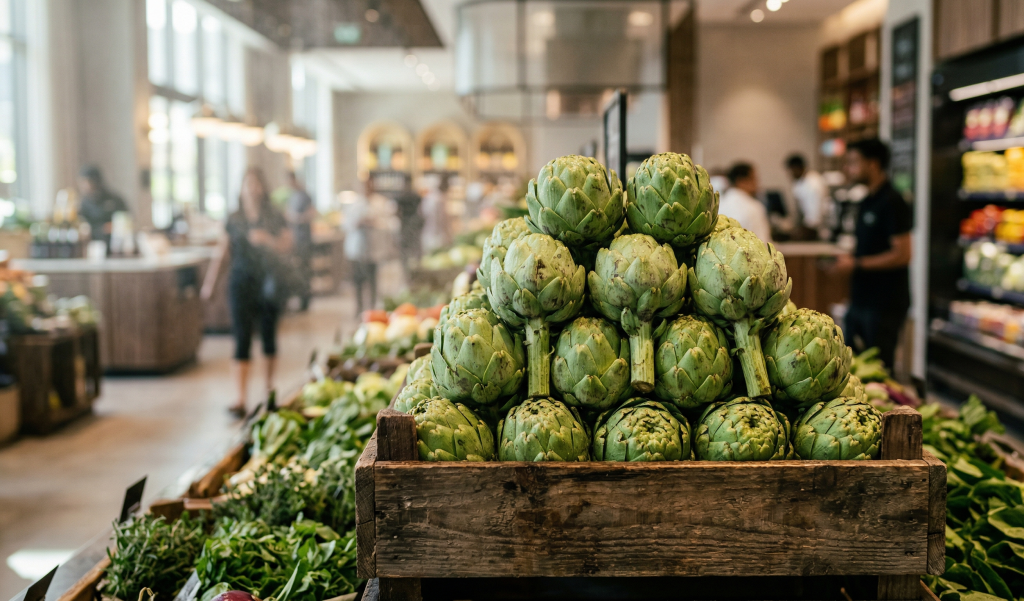
1. Tight, compact leaves
The bud should feel closed. Open leaves usually mean age.
2. Weight for its size
Heavier artichokes tend to be fresher and less dried out.
3. Firmness
It should feel solid, not soft or spongy.
4. Slight squeak when pressed
Fresh leaves often make a light squeaking sound when squeezed.
5. Minimal browning
Light marks are normal, but excessive dark spots indicate aging.
A common sourcing mistake
Many buyers assume larger artichokes are always better.
In reality:
- Smaller to medium sizes are often more tender
- Larger ones can be more fibrous, especially if older
This is especially relevant in Dubai, where supply batches can vary based on origin (Italy, Spain, Egypt).
Seasonal Context: Why Timing Affects Quality
Artichoke is not a year-round stable product in the UAE.
It is primarily an imported item, and its quality depends on harvesting cycles in exporting countries.
Peak availability window:
- Late winter to early spring
During this time:
- Texture is more tender
- Flavor is more balanced
- Shelf life is slightly longer
Outside this window, you may still find supply—but:
- Prices fluctuate
- Quality becomes inconsistent
- Waste risk increases
For restaurants and bulk buyers, this is already understood.
For households, it is often overlooked.
The Real Issue: It’s Not Hard—It’s Just Unfamiliar
Artichoke has a reputation problem.
Not because it is difficult—but because it is not explained properly at the point of purchase.
In practice, suppliers working closely with Dubai-based distributors such as JMB Farm Fresh often observe that once buyers understand basic handling, repeat purchase increases significantly.
That shift does not come from marketing.
It comes from removing uncertainty.
Once buyers realize:
- What part is edible
- How to trim it
- How to cook it simply
The hesitation disappears.
So How Do You Actually Cook It at Home?
This is where most guides either overcomplicate things—or skip steps entirely.
The truth is simpler.
You do not need advanced techniques.
You need a clear, repeatable process.
We will break that down step by step next.
Step-by-Step: How to Cook Fresh Artichoke at Home (Without Overthinking It)
The goal is not to cook artichoke perfectly the first time.
The goal is to cook it correctly enough that it becomes familiar.
Once that happens, it becomes one of the easiest vegetables to repeat.
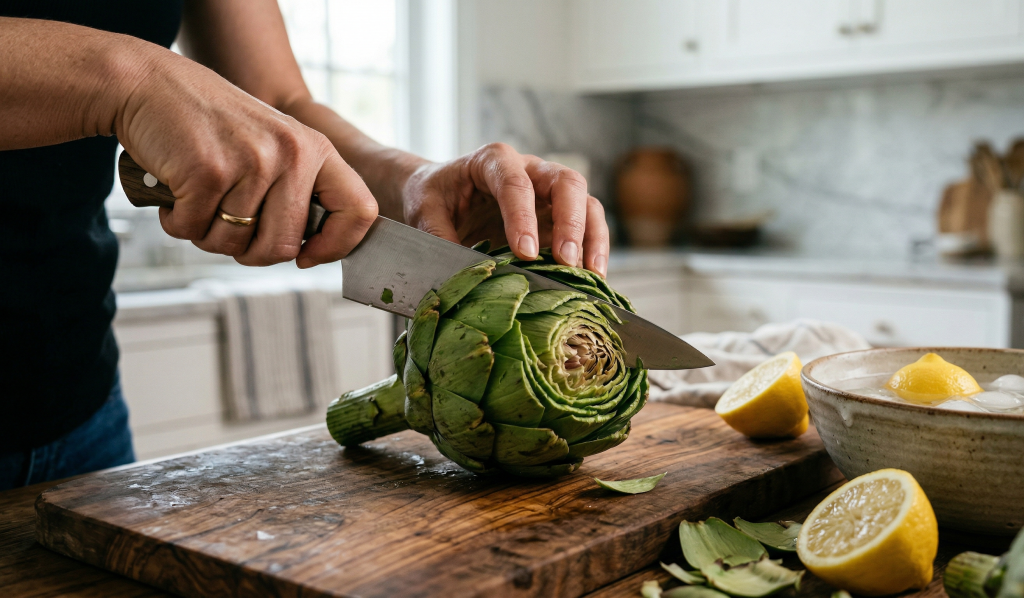
Step 1: Basic Preparation (5–7 minutes)
Start with a whole fresh artichoke.
What you need:
- A knife
- A bowl of water with lemon (to prevent browning)
What to do:
- Cut off the top 1–2 inches of the artichoke
- Trim the stem slightly (leave a bit if it looks fresh)
- Remove the small tough leaves at the base
- Use scissors (optional) to trim sharp leaf tips
Cut it in half lengthwise.
Inside, you will see a fuzzy center. This is the choke.
- Scoop it out using a spoon
- Rinse the artichoke lightly
- Place in lemon water until ready to cook
That is it. No complex knife work required.
Step 2: Choose a Simple Cooking Method
Most home cooking problems come from trying advanced recipes too early.
Start with one of these three methods.
Method 1: Boiling (Most forgiving)
This is the safest starting point.
How:
- Bring salted water to a boil
- Add the prepared artichokes
- Cook for 20–30 minutes
How to check:
- Leaves should pull out easily
- Base should feel tender when pierced
Result:
Soft, mild, easy to eat.
Method 2: Steaming (Better texture)
This keeps more structure compared to boiling.
How:
- Place artichokes in a steamer basket
- Steam for 25–35 minutes
Result:
Slightly firmer, cleaner taste.
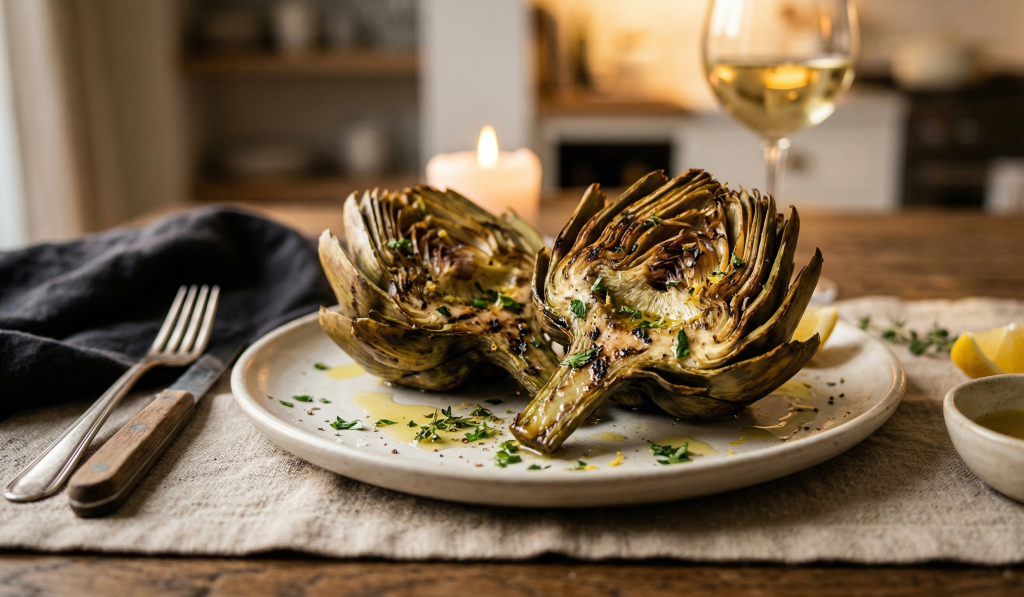
Method 3: Roasting (Closest to restaurant style)
This is where most people recognize the flavor.
How:
- Toss with olive oil, salt, garlic, lemon
- Roast at 200°C for 25–35 minutes
Result:
Golden edges, deeper flavor, less water content.
How Do You Actually Eat It?
This is where most confusion happens.
Artichoke is not eaten in one bite.
The simple way:
- Pull off one leaf
- Dip it (olive oil, lemon, or light sauce)
- Scrape the soft base with your teeth
Once you reach the center:
- The heart is fully edible
- It is the most tender and flavorful part
This part is what most restaurant dishes highlight.
Common Mistakes That Lead to Bad Experiences
Most negative experiences with artichoke come from avoidable issues.
1. Overcooking or undercooking
- Undercooked = tough, fibrous
- Overcooked = mushy, flat
Solution: Test doneness with a knife or by pulling a leaf.
2. Skipping the choke removal
If the fuzzy center is not removed, it becomes unpleasant to eat.
This is one of the main reasons beginners feel they did something wrong.
3. Buying low-quality artichokes
No cooking method can fix poor sourcing.
Dry or old artichokes:
- Stay tough
- Lose flavor
- Feel disappointing
4. Expecting it to behave like other vegetables
Artichoke is not like carrots or broccoli.
It is interactive.
You eat it gradually, not all at once.
Restaurant vs Home: Why the Taste Feels Different
Many people say:
“It tasted better at the restaurant.”
That is usually true—but not for the reasons people think.
Key differences:
1. Pre-preparation
Restaurants often:
- Trim artichokes in advance
- Use acidulated water to preserve color
- Standardize cuts for consistency
2. Fat usage
Restaurants use more:
- Olive oil
- Butter
- Seasoning layers
This enhances flavor significantly.
3. Cooking control
Professional kitchens:
- Cook in batches
- Monitor texture closely
- Avoid overcooking
What this means for home cooks
You do not need to replicate restaurant conditions.
You just need to:
- Use enough seasoning
- Cook until properly tender
- Start with fresh produce
That gets you 80% of the way there.
Fresh Artichoke Benefits (And Why It’s Worth Learning)
Artichoke is not just a niche ingredient.
It has real functional value in both home and commercial kitchens.
Nutritional perspective
Fresh artichoke is known for:
- High fiber content
- Digestive support compounds
- Moderate levels of vitamins and minerals
It is filling without being heavy.
Kitchen value
For restaurants and catering:
- Works across multiple cuisines
- Adds structure to dishes
- Elevates perceived menu value
For households:
- Encourages slower, more mindful eating
- Can replace heavier side dishes
- Offers variety beyond standard vegetables
Wholesale vs Retail: Does It Matter for Artichoke?
This is an important but often misunderstood point.
Retail sourcing (supermarkets)
- Easier access
- Smaller quantities
- Less consistency batch-to-batch
Wholesale sourcing (distributors)
- More consistent supply
- Better handling conditions
- Often fresher due to faster turnover
Tradeoffs
Wholesale is not always “better”—but it is often more predictable.
Retail is not always “worse”—but it can be inconsistent.
Some UAE buyers prefer working with established wholesale produce providers rather than fragmented retail sourcing, especially for items like artichoke where freshness directly affects usability.
The Waste Problem: Why Artichoke Feels Risky to Buy
One of the biggest concerns—especially in Dubai households—is waste.
Artichoke contributes to this perception because:
- Not all parts are edible
- Improper trimming reduces usable portion
- Incorrect storage leads to faster spoilage
How to reduce waste:
- Buy only what you will cook within 2–3 days
- Store in the fridge, unwashed, loosely wrapped
- Prep just before cooking—not in advance
For businesses:
- Pre-trimming can increase labor cost
- But reduces plate waste
- Improves consistency in service
This is why many kitchens choose partially processed formats.
A Practical Reality Most Guides Ignore
Artichoke is not meant to be your daily vegetable.
It is a seasonal, occasional ingredient.
That is exactly why it feels special in restaurants.
Trying to treat it like a staple leads to frustration.
Understanding it as:
- A seasonal product
- With a short learning curve
- And a specific use case
…makes it far easier to work with.
Where Most Online Guides Go Wrong
After reviewing common articles and discussions, a pattern becomes clear.
Most guides:
- Over-explain complex techniques
- Ignore sourcing quality
- Skip practical mistakes
- Assume prior knowledge
What they rarely address:
- Why people hesitate to buy artichoke
- How UAE supply conditions affect quality
- What actually goes wrong in home kitchens
This is where confusion builds.
The Better Approach
Instead of focusing on perfection:
Focus on repeatability.
If you can:
- Select a fresh artichoke
- Trim it simply
- Cook it using one method
…you already know enough.
Everything else improves with practice.
The final piece is understanding how artichoke fits into real Dubai kitchens—both at home and in commercial settings—and how buyers can make smarter decisions around it.
We will break that down next.
How Artichoke Fits into Real Dubai Kitchens (Home vs Commercial Use)
Artichoke behaves very differently depending on where it is being used.
Understanding this difference helps explain why it feels easy in restaurants—and uncertain at home.
In restaurant and hotel kitchens
Artichoke is treated as a planned ingredient, not a spontaneous one.
Chefs usually:
- Order based on menu requirements, not curiosity
- Prep in controlled batches
- Pair it with high-fat elements (olive oil, butter, cheese)
- Use it in dishes where texture matters
It is rarely used alone.
Instead, it supports:
- Pasta dishes
- Grilled platters
- Mezze-style sharing plates
This structure removes most of the risk.
In households
The situation is different.
Most home cooks:
- Buy artichoke out of curiosity
- Attempt one recipe
- Feel unsure about the result
- Do not repeat the purchase
This is not a cooking issue.
It is a familiarity gap.
Once the ingredient becomes familiar, usage becomes natural.
A Practical Way to Start Using Artichoke at Home
Instead of treating it as a complex recipe ingredient, treat it as a simple side first.
Start with this approach:
- Boil or steam the artichoke
- Drizzle with olive oil
- Add salt, lemon, and garlic
That is enough.
Once comfortable, you can expand into:
- Adding it to pasta
- Mixing into salads
- Roasting with other vegetables
The key is not variety.
The key is repetition.
Real-World Buying Scenarios (And What They Teach)
To understand artichoke properly, it helps to look at how different buyers approach it.
Scenario 1: A restaurant buyer
A restaurant sourcing artichoke:
- Chooses consistent size and batch quality
- Plans usage within a fixed menu cycle
- Prioritizes predictability over experimentation
Outcome:
- Minimal waste
- Consistent dishes
- Reliable ordering patterns
Scenario 2: A home buyer
A household purchase often looks like this:
- Buys 2–3 artichokes without prior experience
- Attempts a recipe once
- Faces uncertainty during preparation
Outcome:
- Partial use
- Some waste
- Low likelihood of repeat purchase
The difference is not skill
It is process.
Restaurants remove uncertainty before cooking begins.
Households often encounter uncertainty during cooking.
Import Reality: Why Artichoke Quality Fluctuates in the UAE
Unlike locally grown vegetables, artichoke in the UAE depends heavily on imports.
This creates natural variability.
Common supply origins:
- Italy
- Spain
- Egypt
Each origin has:
- Different harvest timing
- Different size profiles
- Slight variation in taste and texture
What affects what you see in the market:
- Transit time (longer routes reduce freshness)
- Cold chain handling (temperature control during shipping)
- Batch turnover speed (how quickly stock is sold)
This is why one week’s artichoke feels excellent—and another week’s feels average.
A quiet industry observation
Buyers who work consistently with structured supply chains tend to face fewer quality issues than those relying on fragmented sourcing.
In practice, suppliers working closely with UAE distributors such as JMB Farm Fresh often observe that controlled handling and faster turnover improve usability, especially for delicate items like fresh artichoke.
This is not about branding.
It is about logistics.
How to Reduce Risk When Buying Fresh Artichoke in Dubai
Whether you are a home cook or a small business, a few simple adjustments can improve your experience significantly.
1. Buy closer to when you plan to cook
Artichoke is not ideal for long storage.
Shorter gaps between purchase and use:
- Improve texture
- Reduce waste
2. Avoid overbuying
Because not all parts are edible, it is easy to overestimate usable quantity.
Start small.
3. Ask basic questions (if buying from a supplier)
Even simple questions help:
- When was this batch received?
- What is the origin?
- How long is expected shelf life?
These are standard in professional buying—but rarely asked in retail.
4. Observe consistency, not just appearance
One good artichoke does not mean the batch is good.
Consistency matters more than size or color alone.
The Bigger Lesson: Artichoke Is a Skill, Not a Product
Most people treat artichoke like a product decision:
“Should I buy it or not?”
In reality, it is a skill decision:
“Do I understand how to use it?”
Once that shift happens:
- Buying becomes easier
- Cooking becomes predictable
- Waste reduces naturally
Final Thoughts: Why This Ingredient Is Worth Learning
Artichoke sits in an interesting position in the UAE food ecosystem.
It is:
- Common in restaurants
- Available in the market
- But underused at home
Not because of difficulty—but because of unfamiliarity.
Once understood, it becomes:
- A reliable seasonal ingredient
- A flexible addition to meals
- A way to expand beyond standard vegetables
And importantly, it builds confidence in handling other less familiar produce.
FAQ Section
1. What is the easiest way to cook artichoke at home in the UAE?
Boiling or steaming is the easiest method. It requires minimal preparation and gives consistent results, especially for beginners.
2. Where can I buy fresh artichoke in Dubai?
Fresh artichoke is available in larger supermarkets and through produce distributors. Some buyers prefer sourcing from wholesale suppliers for better consistency.
3. How do I know if an artichoke is fresh?
Look for tight leaves, firm structure, and good weight. Avoid artichokes with dry, open, or heavily browned leaves.
4. Why does artichoke taste better in restaurants?
Restaurants use more seasoning, controlled cooking methods, and consistent sourcing, which improves texture and flavor.
5. Can I store artichoke for a long time in the fridge?
It is best used within 2–3 days. Longer storage increases the risk of dryness and reduced quality.








 Home
Home  Whishlist
  Compare
  Checkout