
















Introduction
Food cost problems in restaurants rarely start on the plate.
They usually begin much earlier—at receiving, storage, trimming, and daily prep.
In Dubai, many restaurants believe their produce losses come from staff waste, over-ordering, or menu design. Those factors matter, but they are often secondary. The real losses are quieter and harder to track. They show up as wilted herbs after delivery, inconsistent tomato sizes that break portion control, or vegetables that spoil faster than expected.
These losses don’t look dramatic.
They rarely trigger alarms in accounting software.
But over weeks and months, they quietly erode margins.
This article looks at how restaurants lose money on produce without realizing it. Not through theft or obvious spoilage—but through structural sourcing and handling issues that compound over time. The focus is not on blame, but on understanding where the hidden costs actually live.
Why Produce Loss Is Hard to See in Restaurant Accounting
Produce loss is rarely recorded as a single event.
It spreads across departments and days.
A box of vegetables may be booked correctly at receiving. The invoice matches the order. On paper, everything looks fine. The loss only appears later, broken into small, untracked pieces.
Common places where losses hide:
- Trimming more than expected due to size inconsistency
- Shorter shelf life than assumed in menu planning
- Staff over-prepping to compensate for quality concerns
- Replacing dishes due to poor visual appeal
- Emergency re-orders at higher prices
None of these look like “waste” in isolation. Together, they quietly inflate food cost.
This is why many kitchens feel pressure without seeing a clear cause.
The Produce Quality Gap: When “Fresh” Means Different Things
In Dubai’s supply chain, the word fresh is used broadly.
It does not always mean the same thing to growers, importers, distributors, and chefs.
A tomato can be technically fresh but still unsuitable for a specific kitchen’s workflow.
A cucumber can look fine at delivery but collapse after 48 hours in cold storage.
Quality gaps often come from:
- Harvest timing not aligned with restaurant usage
- Produce bred for transport durability, not kitchen yield
- Mixed sourcing standards within a single order
- Temperature stress during transport or unloading
For restaurants, the cost appears later as reduced usable weight or faster spoilage.
This is especially common when sourcing fresh vegetables for restaurants without clarity on grade, harvest cycle, or intended use.
Inconsistent Sizing: A Silent Enemy of Portion Control
Portion control depends on predictability.
Produce inconsistency breaks that predictability.
When carrots vary widely in diameter or onions arrive mixed in size, kitchens adapt by eye. That adaptation creates loss.
Effects include:
- Larger trim waste on oversized items
- Over-portioning to maintain visual consistency
- Uneven cooking times leading to rejection
- Menu photos drifting away from actual plating
The cost impact is subtle.
Each plate is only slightly off. Across hundreds of covers, it becomes significant.
This problem is common when produce is sourced opportunistically rather than through a consistent restaurant produce supplier in Dubai who understands portion-driven kitchens.
Shelf Life Assumptions vs. Reality
Many ordering decisions rely on assumed shelf life.
Those assumptions often come from experience with different supply conditions.
In the UAE, produce shelf life is influenced by:
- Import transit time
- Humidity exposure at ports
- Cold chain breaks during redistribution
- Seasonal stress on certain crops
Winter produce in the UAE, for example, often looks better on arrival but can be more sensitive to condensation and temperature shifts.
When shelf life is shorter than expected:
- Prep schedules become inefficient
- Inventory turns increase
- Emergency purchases rise
- Staff lose trust in ordering systems
None of these show up as “bad produce.” They show up as operational friction.
Why Price Volatility Distracts From the Real Cost
When prices fluctuate, attention shifts to the invoice.
That’s understandable, but it can be misleading.
A lower-priced box that yields less usable product often costs more per plate.
A stable-priced item with predictable yield is easier to control.
Focusing only on price masks deeper issues:
- Yield loss
- Labor inefficiency
- Menu inconsistency
- Waste during prep
This is why food cost control in the UAE is less about chasing low prices and more about managing variability.
Wholesale vs Retail Sourcing: Where Confusion Begins
Many buyers compare wholesale produce to supermarket quality.
This comparison misses context.
Retail produce is selected for visual appeal and consumer handling.
Wholesale produce is selected for volume movement and durability.
Problems arise when:
- Wholesale grades are not explained clearly
- Restaurants expect retail trimming standards
- Mixed-use suppliers serve households and kitchens the same way
Wholesale sourcing can reduce costs—but only when the product specifications match kitchen needs.
Without that alignment, wholesale sourcing can actually increase waste.
The Human Factor: How Kitchens Compensate for Unreliable Produce
When produce quality is inconsistent, kitchens adapt.
They prep more than needed “just in case.”
They trim aggressively to avoid complaints.
They reorder early to avoid running out.
These behaviors feel responsible.
They also create hidden losses.
Over time, teams stop questioning the source and start normalizing the waste.
This normalization is one of the most expensive blind spots in restaurant operations.
Seasonality in the UAE: When Timing Matters More Than Price
Seasonality in the UAE does not follow the same logic as in temperate countries.
Most produce is imported, and even locally grown vegetables are influenced by controlled environments and water availability.
During the UAE winter months, availability improves for certain crops, but consistency does not always follow.
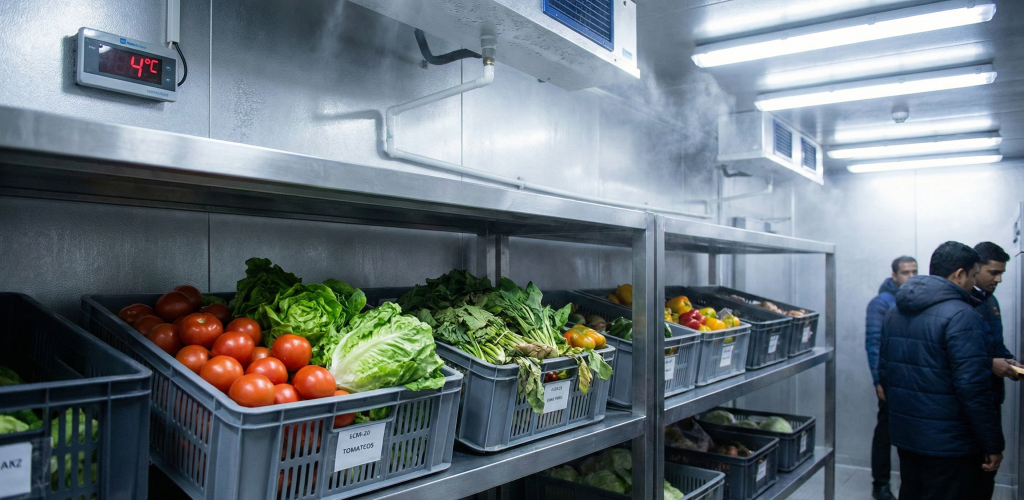
Common winter-related challenges include:
- Higher moisture content in leafy greens
- Condensation during cold storage transitions
- Faster degradation once cartons are opened
- Visual freshness masking internal breakdown
Restaurants often assume winter produce is safer and longer-lasting. In practice, winter can introduce different risks, especially when cold chain handling is uneven.
Understanding seasonality is less about knowing what is available, and more about knowing how that availability behaves in real kitchens.
Import vs Local Produce: The Trade-Offs No One Explains
The local-versus-imported debate is often oversimplified.
Local produce in the UAE can offer:
- Shorter transit times
- Better responsiveness to demand changes
- Reduced handling layers
However, it can also present:
- Greater variability in size
- Limited volume consistency
- Sensitivity to temperature swings
Imported produce, on the other hand, often arrives with:
- More standardized sizing
- Longer shelf-life expectations
- Predictable availability
But it also carries risks:
- Extended cold storage stress
- Delayed harvesting for transport
- Quality decline masked by appearance
The real cost decision is not local versus imported.
It is suitability versus assumption.
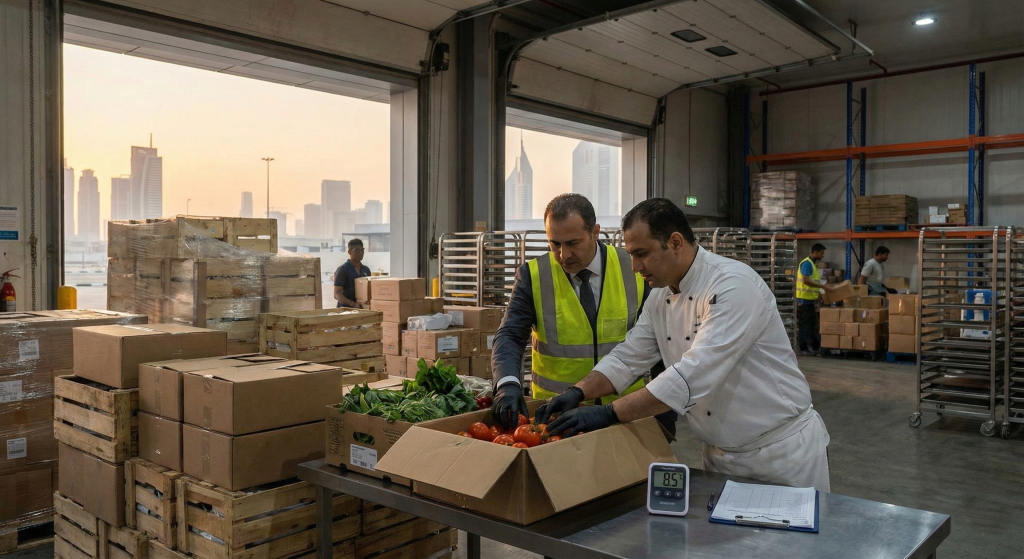
Receiving Is Where Most Losses Begin
Many kitchens treat receiving as a formality.
In reality, it is the most important control point.
Problems that start at receiving:
- Accepting mixed grades without noticing
- Failing to check core temperature
- Stacking produce before inspection
- Signing delivery notes under pressure
Once produce enters storage, options disappear.
Loss becomes inevitable.
Simple receiving discipline reduces waste more than renegotiating prices.
Storage Mismatch: One Chiller Does Not Fit All
Produce does not behave uniformly in cold storage.
Common storage errors include:
- Storing ethylene-sensitive items together
- Using one temperature zone for all vegetables
- Overstacking cartons and restricting airflow
- Ignoring humidity requirements
These are not technical mistakes.
They are operational shortcuts driven by space and time pressure.
Even high-quality produce breaks down quickly when stored incorrectly.
The Cost of Inconsistent Supply Relationships
Many restaurants rotate suppliers frequently to chase price or availability.
This creates hidden instability.
Each new supplier brings:
- Different grading standards
- Different harvest cycles
- Different packing methods
- Different expectations of handling
Kitchens absorb this variation, not accounting systems.
Suppliers who work closely with restaurants over time tend to align product specifications more accurately. In practice, distributors operating steadily in the Dubai market—such as JMB Farm Fresh—often observe that long-term buyers experience fewer yield surprises than those switching sources frequently.
This is not about loyalty.
It is about predictability.
Why Waste Is Often a Symptom, Not the Problem
Most restaurants try to reduce produce waste by:
- Tightening orders
- Training staff to trim less
- Changing menu usage
These help, but they treat the symptom.
Waste usually originates earlier:
- At sourcing decisions
- At grade assumptions
- At delivery acceptance
- At storage setup
Until those points are addressed, waste reduction efforts plateau.
Practical Questions Restaurants Rarely Ask (But Should)
Many costly issues persist because certain questions are never asked.
Examples include:
- What usable yield should we expect from this item?
- How many days does this product realistically last in our setup?
- Is this grade meant for raw presentation or cooking?
- How sensitive is this item to temperature fluctuation?
Asking these questions changes buying behavior more than negotiating.
Where Food Cost Control Really Lives
Food cost control in UAE restaurants is often framed as a numbers exercise.
In reality, it is a systems exercise.
True control comes from:
- Matching produce specifications to menu use
- Understanding seasonal behavior, not just availability
- Reducing variability, not chasing the lowest price
- Treating produce as a living input, not a static commodity
When these elements align, losses become visible—and manageable.
Practical Takeaways for Reducing Invisible Produce Loss
Most restaurants do not need radical changes.
They need clearer alignment between sourcing, handling, and usage.
Practical steps that consistently reduce hidden losses:
- Define expected usable yield, not just delivered weight
- Separate produce by use case (raw, cooked, garnish) at ordering
- Tighten receiving checks during seasonal transitions
- Review storage layout, not just temperatures
- Track spoilage patterns by item, not by total waste
None of these require new software.
They require attention at the right points.
A More Balanced View of Wholesale Produce
Wholesale sourcing is often misunderstood.
Its strengths:
- Better volume pricing stability
- Access to consistent supply lines
- Faster response during shortages
Its limitations:
- Requires clearer specifications
- Demands better receiving discipline
- Punishes assumptions more quickly
Wholesale produce works best when kitchens treat suppliers as part of their operational system, not just as vendors.
Why Experienced Buyers See Less “Surprise Waste”
Seasoned buyers are not immune to losses.
They simply encounter fewer surprises.
They tend to:
- Anticipate seasonal behavior shifts
- Order with yield in mind
- Build routines around inspection and storage
- Maintain fewer, more predictable supply relationships
Over time, this experience compounds into quieter kitchens, calmer prep, and steadier margins.
Conclusion: Seeing the Loss Changes the Outcome
Restaurants in Dubai rarely lose money on produce because of one big mistake.
They lose it through dozens of small mismatches that feel normal.
When produce behaves differently than expected, kitchens adapt.
When that adaptation becomes routine, the loss disappears from view.
The moment restaurants start seeing where the loss actually lives—in yield, consistency, handling, and seasonality—they regain control.
Not through pressure.
Through understanding.
Frequently Asked Questions
Why does produce spoil faster in some Dubai kitchens than others?
Differences usually come from receiving practices, storage setup, and how produce is grouped, not from the supplier alone.
Is local produce always better for restaurants in the UAE?
Not always. Local produce can be fresher but more variable. Imported produce is often more consistent but may carry transport stress.
How can restaurants reduce produce waste without changing suppliers?
Start by improving receiving checks, clarifying grade expectations, and aligning storage conditions to each item.
Why do wholesale vegetables sometimes feel lower quality than supermarket produce?
Wholesale produce is graded for volume and durability. Without clear specifications, it may not match restaurant use cases.
What’s the first step toward better food cost control in UAE kitchens?
Understand usable yield and real shelf life for your top produce items. That insight guides all other decisions.








 Home
Home  Whishlist
  Compare
  Checkout