
















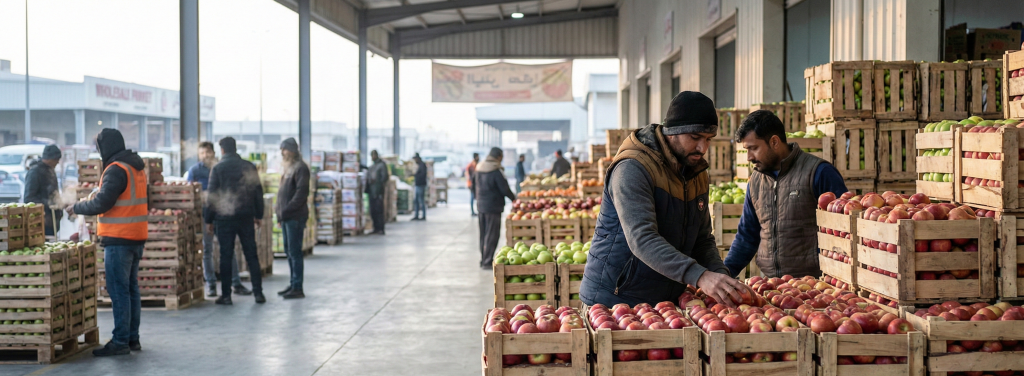
Every winter, demand for apples in UAE markets rises quietly but steadily.
It is not driven by trends. It is driven by habit, nutrition, storage reliability, and Ramadan meal planning.
For families preparing Iftar, for catering companies managing large-scale meal production, and for restaurant buyers building seasonal menus, apples become one of the most dependable fruits in circulation.
They travel well.
They store well.
They work in both sweet and savory dishes.
And during Ramadan — when hydration, digestion, and controlled energy release matter — apples naturally fit the moment.
This article explores why apples in UAE remain a winter staple, how supply patterns shift during the season, what buyers should understand about quality and pricing, and how to use them effectively across households and food businesses.
Why Winter Apples Matter in the UAE Supply Chain
The UAE climate does not support large-scale apple cultivation. That means apples in UAE markets are primarily imported.
Winter, however, aligns with peak harvest periods in major apple-producing countries:
- Europe
- Turkey
- Iran
- China
- South Africa (counter-seasonal supply)
This seasonal alignment improves:
- Fruit firmness
- Sugar balance
- Shelf life
- Export-grade consistency
When apples are harvested in-season and shipped under controlled cold-chain logistics, quality is more predictable.
Off-season imports can still be available, but texture and sweetness often vary.
For procurement managers and grocery buyers, this is a critical distinction.
Winter apples UAE buyers receive are usually closer to harvest timing. That means:
- Better crunch
- More stable storage
- Reduced spoilage risk
During Ramadan, when demand spikes within a short window, that reliability becomes operationally important.
Why Apples Become Popular During Ramadan
Ramadan changes food behavior.
Meals shift to:
- Pre-dawn Suhoor
- Evening Iftar
- Lighter daytime preparation
Energy management and digestion become priorities.
1. Gentle Energy Release
Apples contain natural sugars combined with fiber.
Fiber slows down sugar absorption.
This helps avoid sharp spikes and crashes after Iftar.
For fasting individuals, this matters more than people realize.
2. Digestive Comfort
After a full Iftar meal, digestion can become heavy.
Apples provide:
- Soluble fiber (like pectin)
- Water content
- Light bulk
This supports smoother digestion without heaviness.
3. Hydration Support
While apples are not high-water fruits like watermelon, they still contain a significant moisture level.
In dry winter air — and especially after long fasting hours — even moderate hydration contribution helps.
4. Versatility in Ramadan Menus
Apples are used in:
- Fresh fruit platters
- Date-and-apple salads
- Baked desserts
- Smoothies
- Light compotes
- Stuffed pastries
Restaurants and catering companies prefer ingredients that work across multiple menu formats.
Apples perform well in both premium and budget menus.
What Buyers Often Misunderstand About Apples in UAE
Through industry conversations and procurement discussions, several patterns appear repeatedly.
“All Apples Are the Same”
They are not.
Varieties differ significantly in:
- Firmness
- Sugar levels
- Acidity
- Storage tolerance
- Bruise resistance
For example:
- Some varieties hold structure under baking.
- Others soften quickly and suit fresh consumption only.
Choosing incorrectly increases waste in commercial kitchens.
“Wholesale Quality Is Lower Than Supermarket Quality”
This concern often appears in online discussions.
In reality, wholesale channels and supermarkets frequently source from the same import batches.
The difference lies in:
- Grading
- Handling
- Display practices
Large buyers typically receive cartons directly from cold storage. Retail display handling sometimes introduces more bruising due to customer sorting.
In many cases, wholesale apples in UAE markets are fresher because they move faster through supply cycles.
“If Price Drops, Quality Must Be Lower”
Price fluctuation is usually tied to:
- Shipping container availability
- Fuel costs
- Exchange rates
- Harvest volume in origin countries
A price dip may simply reflect high supply during peak harvest.
Understanding seasonality reduces unnecessary suspicion about quality.
How to Judge Apple Freshness (For Households & Buyers)
Whether buying a few kilos for home or pallets for distribution, the evaluation principles are similar.
Visual Indicators
- Firm skin
- No large soft spots
- Even coloration for the variety
- Minimal stem shrinkage
Minor surface marks do not necessarily mean internal damage.
Touch & Density
A fresh apple should feel heavy for its size.
Softness around the stem or base often signals aging stock.
Aroma
Fresh apples carry a mild, clean scent.
Fermented or sour notes suggest improper storage.
Carton-Level Checks (For Business Buyers)
When inspecting cartons:
- Check bottom-layer bruising
- Confirm cold-chain continuity
- Look for condensation inside packaging
Condensation can indicate temperature fluctuations during transit.
For hospitality operators, even a small lapse in cold storage can reduce shelf life by several days.
Winter Supply Patterns: Import vs Local Perception
Consumers often ask:
“Are these apples local?”
In most cases, apples in UAE are imported. The UAE does not produce apples at commercial scale due to climate constraints.
However, winter availability creates a psychological perception of “seasonal freshness,” which is not incorrect — but the season relates to origin countries, not local farms.
This distinction matters when planning procurement cycles.
Peak global harvests typically align with:
- September to February (Northern Hemisphere)
During these months:
- Freight routes are more active
- Export volumes increase
- Pricing stabilizes
Understanding this cycle helps buyers forecast better.
Common Mistakes During Ramadan Demand Surges
Ramadan creates compressed buying windows.
Mistakes often include:
1. Overordering Too Early
Buying too far in advance increases:
- Cold storage costs
- Shrinkage risk
- Capital lock-up
2. Underestimating Household Demand
Retailers sometimes assume apples are secondary fruit.
In practice, apple demand rises because families seek stable, affordable fruit options that last longer than berries or tropical imports.
3. Ignoring Variety Selection
Choosing a single apple variety for all uses creates menu limitations.
Smart buyers diversify:
- One crisp eating variety
- One baking-friendly variety
This reduces kitchen strain and improves consistency.
Apple Benefits Ramadan UAE Buyers Value Most
When discussing apple benefits Ramadan UAE households care about, the conversation usually centers around practicality rather than trend nutrition.
Key benefits include:
- Easy portion control
- No peeling required
- Long refrigerator life
- Minimal preparation waste
- Stable pricing compared to exotic fruits
For catering operations producing hundreds of Iftar boxes, this matters significantly.
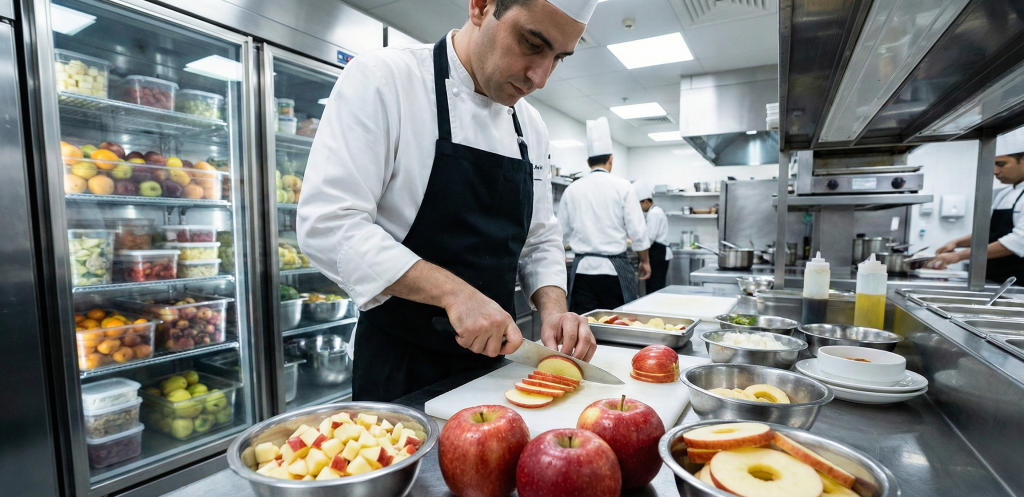
An apple can be packed whole, sliced, juiced, or diced without complicated processing.
Low prep complexity reduces labor hours.
The Operational Advantage of Apples in Food Service
In professional kitchens, predictability is currency.
Apples offer:
- Stable yield ratios
- Low trim waste
- Uniform sizing (export grade)
- Strong structural integrity in transport
Compared to softer fruits, apples tolerate handling better.
In practice, suppliers working closely with Dubai-based distributors such as JMB Farm Fresh often observe that apples move steadily through wholesale channels during Ramadan without dramatic spoilage spikes — unlike more delicate seasonal fruits.
This steady movement improves inventory turnover and reduces unexpected waste costs.
At this point, we’ve examined:
- Seasonal supply behavior
- Ramadan consumption patterns
- Freshness assessment
- Common misconceptions
- Operational advantages
In the next section, we will go deeper into:
- Pricing volatility explained clearly
- How winter apples UAE differ by origin
- Storage science for longer shelf life
- Wholesale vs retail sourcing trade-offs
- Practical recipe applications for households and F&B operators

Understanding Apple Pricing in the UAE: Why Costs Fluctuate
Pricing volatility is one of the most misunderstood aspects of buying apples in UAE wholesale and retail markets.
Buyers often assume that price shifts indicate quality changes.
In reality, pricing reflects supply chain mechanics.
1. Origin Country Harvest Cycles
Apple harvest volumes differ by region and season.
If Europe experiences a strong crop year:
- Export supply increases
- Per-carton prices may soften
If frost or weather issues affect harvest:
- Export volumes tighten
- Prices rise, even if fruit quality remains high
These changes are agricultural realities, not market manipulation.
2. Freight and Cold-Chain Costs
Apples require refrigerated transport (cold chain).
Shipping container availability, fuel pricing, and port congestion all affect landed cost in UAE.
Even small temperature disruptions during transit can:
- Reduce storage life
- Increase hidden waste
When freight costs rise globally, fruit pricing adjusts accordingly.
3. Currency Exchange Movements
Most apple imports are priced in foreign currencies.
Exchange rate fluctuations impact wholesale pricing in Dubai and other Emirates.
For procurement managers working on fixed Ramadan budgets, this is important to monitor.
Winter Apples UAE: Do Origins Matter?
Yes — but not always in the way buyers assume.
Different origin countries offer different advantages.
European Apples
Often known for:
- Crisp texture
- Balanced sweetness
- Strong grading consistency
They typically arrive during peak Northern Hemisphere harvest cycles.
Turkish and Iranian Apples
Commonly available in regional trade routes.
Strengths include:
- Competitive pricing
- Shorter shipping distance
- Good freshness during winter
Chinese Apples
Often uniform in appearance and size.
However, longer transit distances require strong cold-chain reliability.
South African Apples
Available during counter-seasonal periods.
Useful when Northern Hemisphere supply tightens.
For buyers, the key question is not “Which origin is best?”
It is:
“Which origin aligns with current season, storage needs, and price stability?”
Storage Science: Extending Shelf Life Without Compromising Quality
Apples are resilient, but improper storage shortens usability quickly.
Ideal Storage Conditions
- Temperature: 0–4°C
- High humidity (but not wet conditions)
- Minimal temperature fluctuations
When apples are repeatedly moved between cold and warm environments:
- Condensation forms
- Skin weakens
- Spoilage accelerates
For households, this means:
Store apples in the refrigerator, not on open kitchen counters during warm indoor conditions.
For restaurants and caterers:
Avoid frequent cold room door openings during peak service hours.
Even small temperature increases reduce shelf life.
Controlled Atmosphere Storage (CA Storage)
In large supply chains, apples are often stored in low-oxygen environments.
This slows respiration (natural aging process).
Most buyers never see this process, but it explains why apples can remain crisp months after harvest.
Understanding this helps explain why winter apples UAE markets receive can still feel freshly picked.
Wholesale vs Retail Sourcing: A Balanced View
There is ongoing debate in online discussions about whether wholesale sourcing offers better value than retail purchasing.
The answer depends on scale.
When Wholesale Makes Sense
- Restaurants
- Catering companies
- Hotel F&B departments
- Large households
Advantages:
- Bulk pricing stability
- Carton-level quality control
- Direct cold storage movement
- Consistent size grading
Tradeoffs:
- Larger volume commitment
- Storage responsibility shifts to buyer
- Less flexibility for small quantity adjustments
When Retail Is Practical
- Small households
- Low consumption frequency
- Limited storage capacity
Retail advantages:
- Small quantities
- Immediate consumption
- No storage planning required
However, repeated small purchases often increase overall cost per kilo.
Experienced grocery buyers understand this balance.
Some UAE operators prefer working with established wholesale produce providers rather than fragmented retail sourcing because it improves cost predictability during high-demand periods like Ramadan.
Real-World Scenario: Iftar Catering at Scale
Consider a catering company preparing 1,000 Iftar boxes daily.
Each box includes:
- Dates
- Main dish
- Salad
- Whole apple
If apples are inconsistent in size:
- Packaging balance suffers
- Portion perception changes
If apples bruise easily:
- Waste increases
- Replacement costs rise
If apples soften too quickly:
- Customer experience declines
Choosing the correct variety and maintaining cold chain from supplier to packing facility becomes operationally critical.
Apples are simple fruit — but in high volume, small mistakes multiply.
Practical Apple Uses During Ramadan
Apples are often viewed as “basic,” but their culinary flexibility is underestimated.
For Households
- Fresh slices with dates
- Apple and cucumber salad with lemon
- Baked apple with cinnamon
- Apple smoothies for Suhoor
Because apples require minimal preparation, they reduce kitchen workload during already busy evenings.
For Restaurants & Cafés in Dubai
- Apple-based mocktails
- Caramelized apple dessert plates
- Apple chutney with grilled meats
- Apple coleslaw variations
Winter apples UAE supply provides stable firmness ideal for slicing and plating.
For Hotels
- Breakfast buffets (long display tolerance)
- Compote for pastry sections
- Apple-infused water stations
Compared to soft berries, apples maintain structure longer under buffet lighting.
Managing Waste: The Hidden Cost Buyers Care About
Food waste is rarely discussed publicly, but it is a core concern among professional buyers.
Common apple waste causes include:
- Poor rotation practices
- Mixed old and new stock
- Overexposure to warm air
- Bruising during transport
Simple preventive steps:
- Use FIFO (First In, First Out) rotation
- Separate damaged cartons immediately
- Maintain consistent refrigeration
- Train staff not to drop cartons
Even 5% reduction in waste can significantly improve margins for medium-sized F&B operators.
Consumer Behavior During Winter in UAE
Winter in the UAE encourages outdoor gatherings, Ramadan tents, and communal meals.
Fruit consumption increases during:
- Family Iftars
- Corporate Ramadan events
- Hotel buffets
Apples benefit from:
- Familiarity
- Neutral flavor profile
- Universal acceptance across cultures
Unlike exotic fruits, apples rarely face resistance from children or older guests.
This universal acceptance strengthens their seasonal demand.
We’ve now examined:
- Pricing dynamics
- Origin differences
- Storage science
- Wholesale vs retail tradeoffs
- Real-world food service scenarios
- Practical Ramadan uses
Next, we will cover:
- Risk awareness when sourcing apples in UAE
- How to forecast Ramadan demand responsibly
- Long-term supplier relationships
- Final takeaways
- FAQs and SEO elements
Risk Awareness When Sourcing Apples in UAE
Most apple purchases go smoothly.
But experienced buyers know that small oversights can create supply disruptions, especially during Ramadan when demand compresses into a short period.
1. Sudden Demand Spikes
In the two to three weeks before Ramadan, wholesale markets often experience volume pressure.
If buyers delay planning:
- Preferred varieties may sell out
- Size grading becomes limited
- Prices tighten
Forecasting demand at least 3–4 weeks ahead reduces stress.
2. Over-Reliance on a Single Origin
Depending entirely on one origin country increases risk exposure.
Weather, port delays, or inspection backlogs can interrupt shipments.
Diversifying origin sources reduces vulnerability.
3. Ignoring Cold-Chain Gaps
Even a strong product can deteriorate quickly if:
- Delivered without proper temperature control
- Left at loading docks
- Stored inconsistently
Apples may look fine externally while internal quality declines.
Regular inspection upon delivery is essential.
Forecasting Ramadan Apple Demand: A Practical Approach
Demand forecasting does not require complex software.
It requires realistic assumptions.
For Households
Consider:
- Number of family members
- Planned gatherings
- Consumption frequency
Apples store well. Buying in moderate bulk is reasonable — but only if refrigeration space is available.
For Restaurants & Caterers
Forecast using:
- Historical Ramadan sales data
- Portion size consistency
- Event bookings
- Menu commitments
Avoid relying solely on last-minute daily purchases.
Short-term buying during peak demand often increases cost and reduces size selection.
Building Long-Term Supplier Stability
Produce sourcing is often treated as transactional.
In reality, consistency improves when relationships are stable.
Established wholesale networks tend to:
- Maintain structured grading standards
- Communicate supply changes early
- Adjust forecasts collaboratively
In practice, suppliers operating within Dubai’s structured distribution ecosystem — including distributors such as JMB Farm Fresh — observe that repeat buyers who plan seasonally experience fewer quality disruptions during Ramadan compared to reactive buyers.
The lesson is simple:
Seasonal produce behaves best when planning respects seasonality.
Apples in UAE: A Winter Fruit With Strategic Value
It is easy to overlook apples because they are common.
But in the UAE’s winter and Ramadan context, they provide rare advantages:
- Strong storage tolerance
- Balanced nutrition profile
- Cross-cultural appeal
- Stable global supply chains
- Low preparation complexity
They reduce risk compared to delicate fruits.
They support digestion after heavy meals.
They integrate smoothly into both traditional and modern menus.
For grocery buyers, they offer steady turnover.
For caterers, they offer packaging stability.
For families, they offer simplicity and reliability.
Winter apples UAE markets receive are not trendy — but they are practical.
And in food supply, practicality often matters more than novelty.
Conclusion
Apples in UAE play a quiet but important role during winter and Ramadan.
Their value does not come from marketing claims.
It comes from:
- Agricultural timing
- Cold-chain science
- Menu versatility
- Predictable handling
Understanding origin cycles, storage practices, and demand forecasting allows buyers to make smarter decisions.
Whether sourcing for a household kitchen in Dubai or a hotel buffet serving hundreds nightly, apples remain one of the most stable and useful winter fruits available.
In a season defined by fasting, gathering, and thoughtful consumption, their reliability earns its place.
FAQs
1. Why are apples more popular in UAE during Ramadan?
Apples provide gentle energy, digestive support, and long shelf life. They are easy to portion and work well in Iftar meals and catering boxes.
2. Are apples grown locally in UAE?
No. Most apples in UAE are imported due to climate limitations. Winter availability aligns with harvest seasons in exporting countries.
3. Do wholesale apples differ from supermarket apples?
Often they come from similar import batches. The difference usually lies in grading, handling, and display methods rather than source quality.
4. How long can apples be stored in UAE homes?
When refrigerated at consistent cold temperatures, apples can last several weeks. Avoid temperature fluctuation to extend freshness.
5. Why do apple prices fluctuate during winter?
Pricing reflects harvest volumes, freight costs, and currency exchange rates — not necessarily changes in quality.








 Home
Home  Whishlist
  Compare
  Checkout